
Learn How Alzheimer’s Creeped Into My Brain
How Did I Get Alzheimer's?
The question haunted me from the day I heard the diagnosis.
What changed inside my brain?
I had exercised, stayed active, and tried to live a healthy life. Yet I was sitting in a neurologist's office being told I had early Alzheimer's disease. Like most people, when I was diagnosed in 2024, I believed Alzheimer's was simply a disease of amyloid plaques, tau tangles, memory loss, and an incurable future.
Over the next two years, I discovered how incomplete that picture really was.
As I immersed myself in the scientific literature, I realized that our understanding of Alzheimer's is changing rapidly. New imaging techniques, blood biomarkers, and long-term research studies are transforming what scientists know about how the disease begins and progresses. Rather than viewing Alzheimer's as a disease as incurable and only recognizable when memory loss appears, researchers now recognize it as a slow biological process that unfolds silently over decades. Each new study adds another piece to the puzzle, helping build a clearer picture of how Alzheimer's develops long before symptoms appear.
The more I learned, the more I realized that although Alzheimer's symptoms may seem to appear suddenly, the disease itself often begins 20 to 30 years earlier. It develops quietly over two or three decades before the first forgotten name or misplaced key. By the time I was diagnosed, Alzheimer's had likely been unfolding inside my brain for decades.
Looking back, the earliest biological changes may have begun when I was about fifty-five years old. At the time, I felt perfectly normal, but I was ignoring my lack of sleep and being overweight. I was working full-time, commuting more than an hour each way, getting up at 4:00 AM every morning to avoid a longer commute, and carrying about fifteen extra pounds. Was that the problem? There is no way anyone could know that the biological processes leading to my diagnosis had already begun.
I cannot change when the disease started, nor why it might have started, but I can understand how it developed. And that understanding helps me understand what scientists are focused on and why.
Today, scientists know that Alzheimer's is far more complex than plaques and tangles alone. The disease begins with subtle changes in the brain's ability to clear beta-amyloid protein, progresses through the formation of toxic oligomers that disrupt communication between neurons, triggers inflammation, promotes tau pathology, plaques exacerbate all of these and eventually leads to the loss of synapses and neurons. Understanding this sequence helps explain why newer treatments are designed to intervene much earlier in the disease process than ever before. But at this time we can only start treatments like Leqembi and Kisunla when biomarkers prove Alzheimer’s is present and has already done a good deal of damage.
Knowledge cannot change the past, but it can change the future. By understanding how Alzheimer's develops, from the earliest changes in beta-amyloid through the spread of tau and the gradual loss of neurons, we can make more informed decisions about the treatments available today while appreciating the promise of therapies still being developed. Every new discovery brings us closer to slowing, delaying, or perhaps one day preventing this disease altogether. That is a future filled not with fear, but with hope.
Alzheimer’s Timeline
The timeline below illustrates what researchers now believe is the typical biological progression of Alzheimer's disease. Rather than beginning with memory loss, Alzheimer's starts decades earlier with subtle changes that occur silently inside the brain. As the disease progresses, one biological event triggers the next, eventually leading to the symptoms we recognize as Alzheimer's.
The first chart summarizes the approximate sequence of events based on our current understanding of the disease. The second chart highlights findings from a recent 20-year study that tracked Alzheimer's biomarkers long before diagnosis, providing some of the strongest evidence that the disease develops gradually over many years.
Although researchers continue to refine the details, the overall picture is now clear: Alzheimer's is a slow, progressive biological process that begins decades before symptoms appear. In the pages that follow, we'll examine each stage—from the brain's normal production of beta-amyloid, to the formation of toxic oligomers, fibrils, plaques, and tau tangles, and finally the loss of neurons that leads to memory loss and cognitive decline. Understanding this progression explains not only how Alzheimer's develops, but also why today's treatments target specific stages of the disease and why early diagnosis offers the best opportunity to preserve brain function.
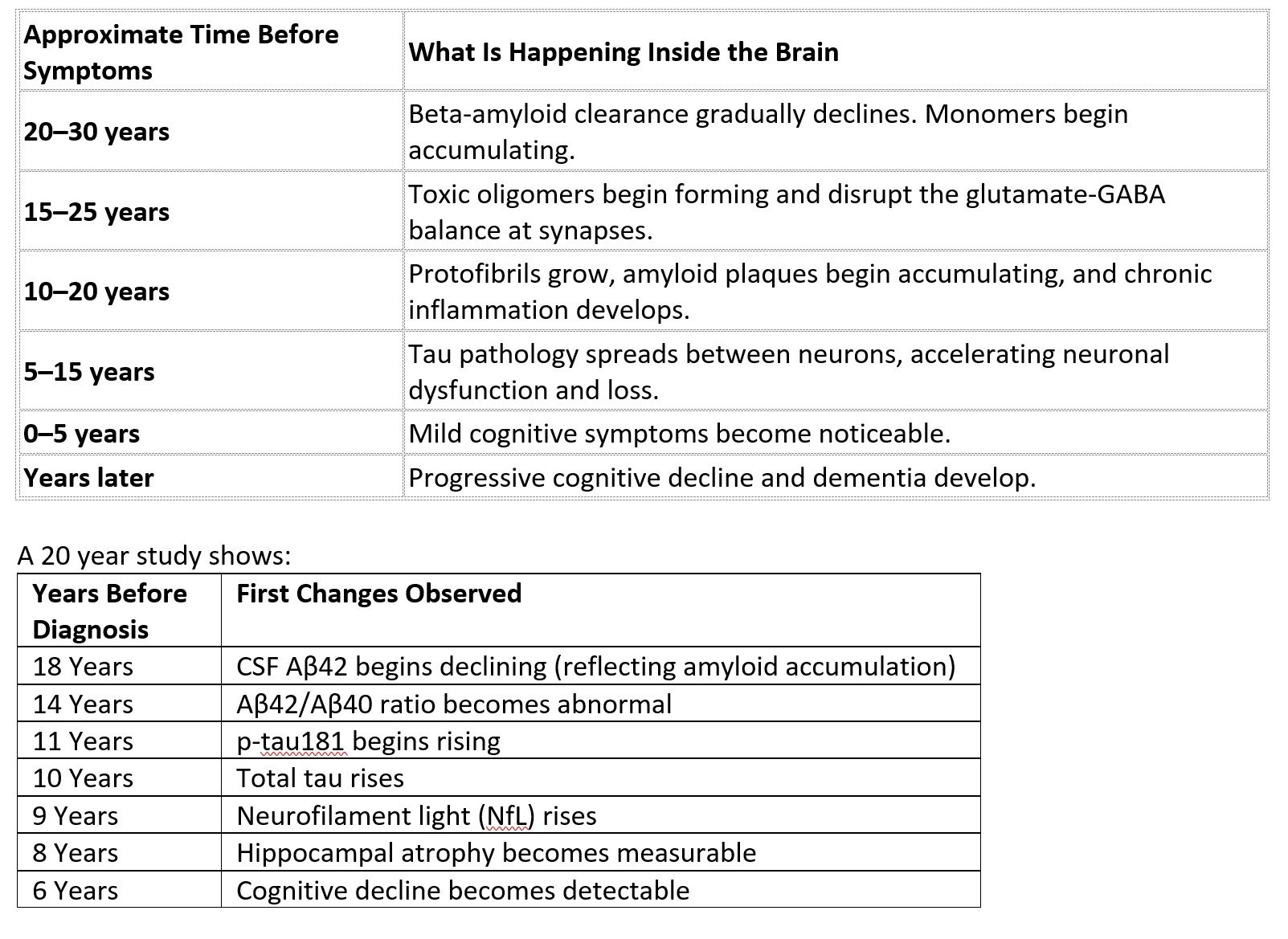
Alzheimer’s Timeline
The Silent Phase (20–30 Years Before Symptoms)
Every healthy brain continuously produces beta-amyloid throughout life. Contrary to what many people believe, beta-amyloid is not inherently harmful. Under normal conditions it helps regulate communication between neurons, supports learning and memory, and may even help protect the brain from infection.
The problem is not producing beta-amyloid, the brain has always done that.
The key is removing the excess.
Under normal conditions, old beta-amyloid is efficiently removed through several complementary clearance systems. Enzymes degrade beta-amyloid, microglia engulf and digest it, transport proteins move it across the blood-brain barrier, and the glymphatic system clears it into our veins to be eliminated. This happens every night during deep, slow-wave sleep.
With aging, these clearance mechanisms gradually become less efficient. Sleep quality often declines, glymphatic clearance slows, transport across the blood-brain barrier decreases, microglia become less effective, and enzymes responsible for degrading beta-amyloid diminish in activity. Vascular disease and the APOE ε4 genetic variant can further reduce clearance.
This clearance problem is like a household drain. Each day, a tiny amount of grease sticks to the inside of the pipe. One day's buildup is insignificant, but over years those thin layers accumulate, narrowing the pipe until water can no longer flow freely. In much the same way, tiny amounts of beta-amyloid that escape the brain's normal cleanup gradually build up over decades, eventually creating the conditions that lead to Alzheimer's disease.
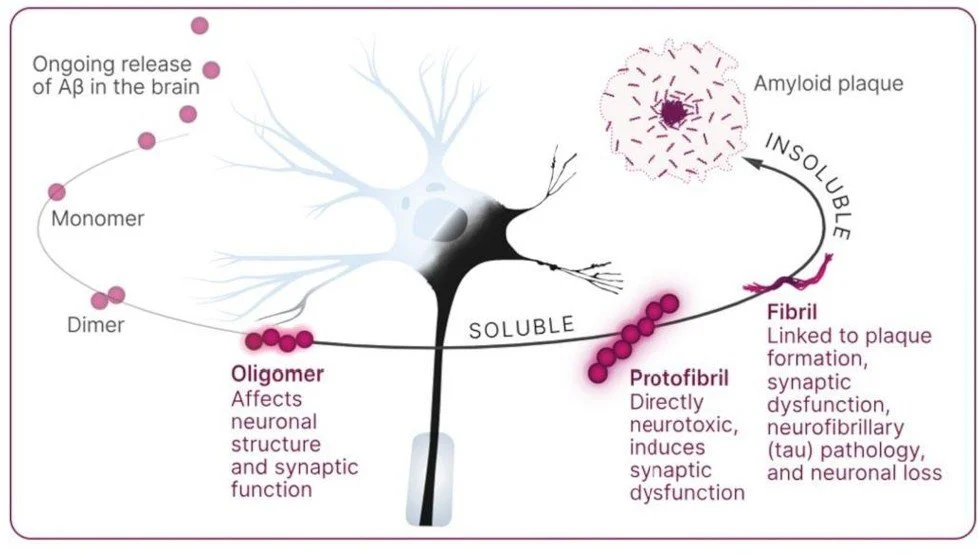
Oligomers: The Earliest Toxic Stage (15–25 Years Before Symptoms)
As beta-amyloid gradually accumulates in the brain because normal production exceeds clearance, some of the individual molecules begin to misfold, become prone to sticking together, and bind to one another, first forming dimers and then larger soluble clusters called oligomers.
When toxic beta-amyloid oligomers begin to form, one of their first targets is the synapse, the tiny gap where neurons communicate. Oligomers attach to the surface of synapses and interfere with the receptors that regulate normal communication. As a result, glutamate signaling becomes excessive, disrupting the balance between glutamate and GABA.
Glutamate and GABA provide us with a process most of us have never heard of. Throughout the brain, neurons continuously maintain a delicate balance between glutamate, which excites neurons, and GABA, which inhibits them, creating the precise level of communication needed for healthy brain function while preventing harmful overactivity. Every thought, memory, movement, and conversation depends on these two chemicals remaining in balance. Imagine driving a car. Glutamate presses the gas pedal. GABA applies the brakes. Neither one is "good" or "bad." You need both to arrive safely. When this balance is disrupted persistent overexcitation, called excitotoxicity, places tremendous stress on neurons and their synapses.
Oligomers also damage neurons directly. They create tiny openings in the cell membrane that allow too much calcium to enter the cell. The calcium overload activates destructive enzymes, damages mitochondria that produce the cell's energy, and increases oxidative stress, in which harmful molecules attack proteins, DNA, and cell membranes. Together, these changes gradually weaken neurons.
As oligomers accumulate, they also activate microglia, the brain's resident immune cells. Initially these cells attempt to remove the toxic proteins, but prolonged activation leads to chronic inflammation that damages healthy neurons and accelerates the loss of synapses.
Finally, mounting evidence suggests that oligomers help trigger the abnormal changes in tau that eventually lead to neurofibrillary tangles, the second hallmark of Alzheimer's disease. Scientists believe the stress they create causes tau proteins to detach from the neuron's internal support system and clump into tangles. These tangles block the transport of nutrients within the neuron, eventually causing the cell to die.
By disrupting communication, overexciting neurons, damaging brain cells, promoting chronic inflammation, and triggering tau tangles, oligomers are now believed to be one of the earliest and most toxic drivers of Alzheimer's disease. Scientists now believe oligomers begin disrupting synapses years before amyloid plaques become a major feature of the disease.
Protofibrils, Fibrils and Plaque Formation (10–20 Years Before Symptoms)
As oligomers continue to aggregate, they form larger soluble structures called protofibrils. Imagine making a rope. Individual threads are first twisted into small strands. Those strands are woven into thicker cords, and the cords are braided together to form a strong rope. Beta-amyloid follows a similar progression. Toxic oligomers join together to form longer protofibrils, which then assemble into long fibrils. Finally, these fibrils pack together to create the dense structural framework of an amyloid plaque. Like the growing strands of a rope, each stage builds upon the previous one, producing larger, more stable structures that become increasingly difficult for the brain to eliminate.
These elongated assemblies continue many of the damaging processes initiated by oligomers but are more stable and persist longer within brain tissue. They promote synaptic dysfunction, neuroinflammation, oxidative stress, and further neuronal injury, allowing damage to spread over time.
As protofibrils continue to assemble, they form long, insoluble fibrils. Fibrils are long, insoluble fibers formed when beta-amyloid molecules lock together into highly ordered strands that become the structural framework of amyloid plaques. Although fibrils are less acutely toxic than soluble oligomers, they still contribute to disease progression by promoting chronic inflammation, impairing synaptic communication, accelerating the spread of tau pathology, and contributing to the gradual loss of neurons.
As additional fibrils accumulate, they intertwine to form amyloid plaques, dense, insoluble deposits that become permanently lodged between neurons. Unlike the smaller oligomers that drift through the brain attacking synapses, plaques remain largely stationary and cannot be readily broken down or removed by the brain's normal waste-clearance systems.
Despite their immobility, plaques create a toxic environment in the surrounding brain tissue. Microglia and astrocytes gather around them in an attempt to remove the deposits, but because plaques are so difficult to clear, this immune response becomes chronic. Instead of restoring healthy tissue, these cells continuously release inflammatory chemicals, free radicals, and other toxic substances that injure nearby neurons.
Plaques also appear to serve as reservoirs for toxic beta-amyloid species. Soluble oligomers can continue to form on and around their surface, disrupting communication between neighboring neurons. At the same time, plaques contribute to the formation and spread of tau pathology and impair the brain's natural waste-removal systems. Together, these processes accelerate the loss of synapses and neurons, leading to progressive memory loss and cognitive decline.
Tau Pathology (5–15 Years Before Symptoms)
The chronic cellular stress caused by beta-amyloid oligomers, protofibrils, amyloid plaques, and the inflammation they trigger, produces profound changes in tau, the second major hallmark of Alzheimer's disease.
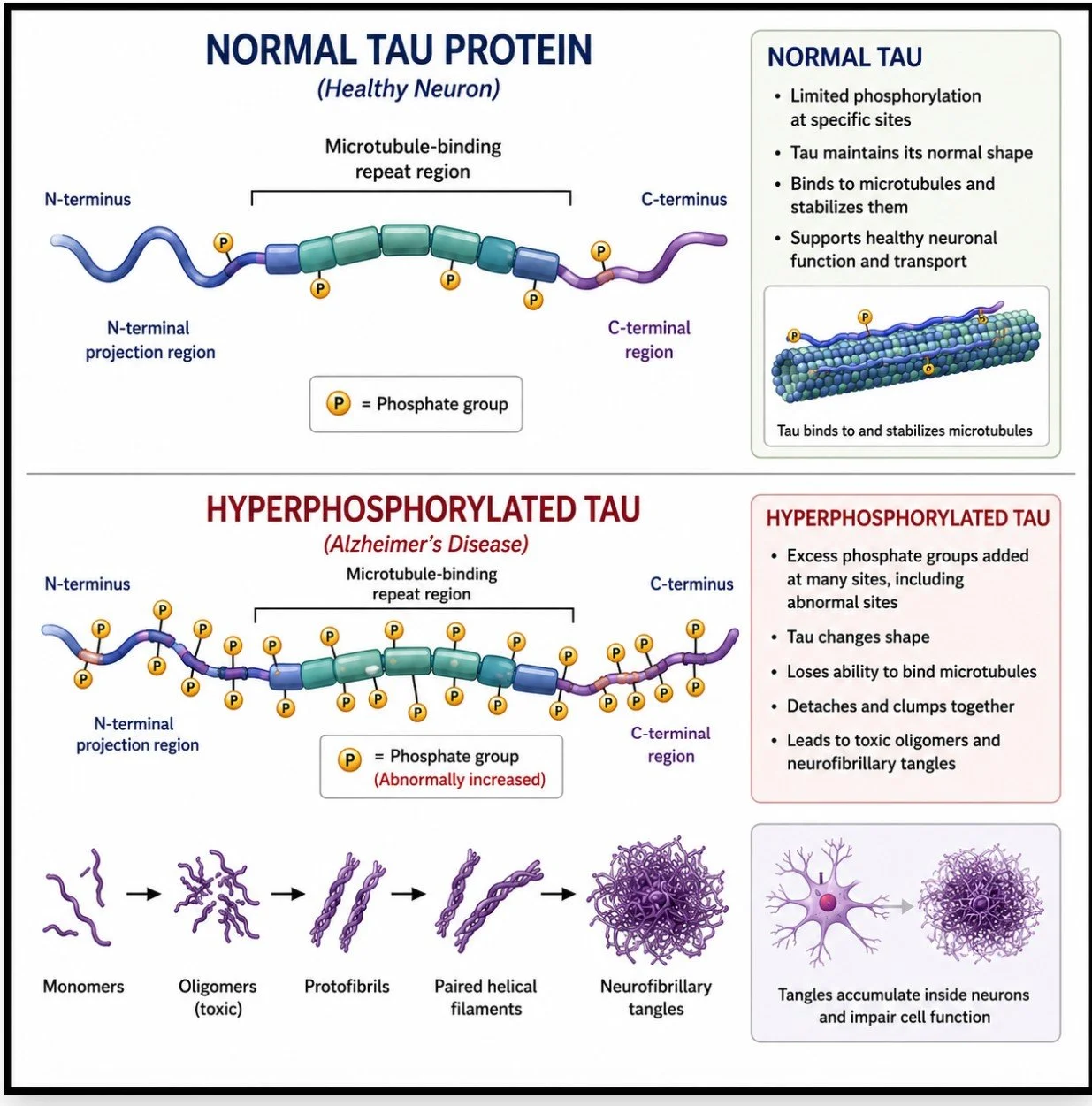
Under healthy conditions, tau binds to microtubules, the microscopic tracks that form the neuron's internal transportation system. Like railroad tracks, these microtubules allow nutrients, proteins, mitochondria, and other essential materials to move efficiently from the cell body down the axon to distant synapses and back again. This constant flow keeps neurons healthy and allows them to communicate with one another.
As chronic stress from toxic beta-amyloid, inflammation, oxidative damage, and calcium overload increases, tau becomes hyperphosphorylated, causing it to detach from the microtubules. Without tau to stabilize them, the transport system begins to break down. The abnormal tau proteins then start sticking together, following a process remarkably similar to beta-amyloid aggregation. Healthy soluble tau first becomes phosphorylated tau, then assembles into tau oligomers, tau protofibrils, tau fibrils, and finally neurofibrillary tangles inside the neuron.
Phosphorylated Tau → Tau Oligomer → Tau Protofibril → Tau Fibril → Tau Tangle
Like the building blocks of amyloid plaques, each stage produces progressively larger and more stable aggregates. As these tau aggregates grow, they further disrupt the neuron's transportation system, slowing the movement of nutrients, mitochondria, proteins, and the molecular machinery needed for normal communication. Synapses begin to fail as they are deprived of the materials required to send and receive signals. At the same time, small tau oligomers and protofibrils can travel along axons to synapses, where they are released and taken up by connected neurons. Once inside the receiving neuron, they act as seeds, triggering healthy tau proteins to misfold and begin forming new tau aggregates.
As neurons become increasingly damaged, additional tau seeds, including small aggregates and protein fragments, can escape into the surrounding tissue and be absorbed by neighboring neurons. These seeds restart the entire sequence of tau oligomers → protofibrils → fibrils → tangles, allowing tau pathology to spread from one neural pathway to another. Over time, this progressive spread destroys synapses, interrupts communication between brain regions, and ultimately leads to widespread neuronal death.
Today, many researchers believe that while beta-amyloid initiates the disease process, tau pathology is more closely linked to neuronal death and the severity of cognitive impairment. Beta-amyloid may light the match, but the spread of tau pathology fuels the fire that ultimately destroys the brain's communication network.
Mild Cognitive Impairment (0–5 Years Before Symptoms Become Noticeable)
As tau pathology spreads from neuron to neuron, the neuron's internal transportation system progressively breaks down. Essential nutrients and proteins can no longer move efficiently within the cell, leading to neuronal dysfunction, loss of synapses, and eventually the death of the neuron.
At first, the brain is remarkably resilient. Nearby neurons often compensate by strengthening existing connections or creating new ones, allowing many people to function normally for years despite ongoing damage. This remarkable ability, known as brain plasticity, helps explain why Alzheimer's disease can develop silently for many years before symptoms become noticeable.
As more neurons and synapses are lost, however, the brain can no longer compensate. Neural networks become fragmented, making it increasingly difficult for different regions of the brain to communicate. Information is processed more slowly, memories become harder to retrieve, words become more difficult to find, decisions take longer to make, and tasks that once seemed automatic require greater effort. Eventually, entire networks responsible for memory, language, reasoning, and problem-solving begin to fail.
Unlike many cells in the body, most neurons cannot be replaced once they die. Their loss is permanent. But the greatest impact is not the loss of a single neuron, it is the loss of the millions of connections that neuron made with other neurons throughout the brain.
Think of each neuron as a major power substation in a vast electrical grid. Every neuron receives electrical signals from thousands of other neurons, processes that information, and sends new signals to thousands more. If one substation fails, electricity must be rerouted through neighboring stations. As more substations fail, the entire grid becomes less efficient, increasing the risk of overloads and widespread outages.
Alzheimer's disease is much like a slowly failing electrical grid. It is not simply the loss of individual neurons; it is the gradual breakdown of the brain's communication network. Every neuron that dies weakens the intricate web of connections that allows us to think, remember, learn, and understand the world around us.
The Appearance of Symptoms
Clinical symptoms emerge only after years of accumulating pathology. By the time memory loss becomes noticeable, impaired beta-amyloid clearance, toxic oligomers, chronic inflammation, amyloid plaques, tau tangles, and neuronal loss have typically been progressing for two or three decades.
Understanding this long timeline has transformed the way scientists think about Alzheimer's disease. Rather than viewing memory loss as the beginning of Alzheimer's, researchers now recognize it as one of the final stages of a disease that has been silently unfolding for years.
This new understanding has also transformed treatment. Current anti-amyloid therapies, like Leqembi, cannot reverse neurons that have already died. Instead, it is designed to remove toxic forms of beta-amyloid and slow the disease before extensive, irreversible damage occurs. The earlier treatment begins, the greater the opportunity to preserve healthy neurons and the neural networks they support.
Researchers are now focused on identifying Alzheimer's during its earliest biological stages, years before symptoms appear, when intervention may prevent or substantially delay the cascade of events that ultimately leads to cognitive decline.
Closing Thoughts
For decades, Alzheimer's disease was recognized only after memory problems became obvious. Today, science tells a very different story. We now know that Alzheimer's begins many years before the first symptom, progressing through a series of biological changes that slowly damage the brain's communication network. This deeper understanding has changed not only how we diagnose the disease, but also how and when we treat it.
The goal of the future is no longer to wait for symptoms and react to them. The goal is to identify Alzheimer's as early as possible, intervene before widespread neuronal loss occurs, and preserve the brain's ability to think, learn, and remember. That shift from treating symptoms to targeting the underlying biology has led to the first disease-modifying therapies and offers genuine hope that future treatments will become even more effective.
The goal for those of us already impacted by decades of damage to our brains is to stop it's progression. Leqembi is a great start, as it clears both plaques and oligomers. Now those like me are anxiously awaiting a way to stop the tau tangles and its seeds from spreading.
References
Andersen, J. (2025). Glutamate-glutamine cycle. Retrieved from Wikipedia: https://en.wikipedia.org/wiki/Glutamate%E2%80%93glutamine_cycle?
Buche, M. A. (2016, August 16). Impairment of neural circuit function in Alzheimer's Disease. Retrieved from National Library of Medicine: https://pubmed.ncbi.nlm.nih.gov/27377723/
Haass, C. S. (2007, February). Soluble protein oligomrs in neurodegeneration: lessons from the Alzheimer's amyloid beta-peptide. Retrieved from National Library of Medicine: https://pubmed.ncbi.nlm.nih.gov/17245412/
Illodo, S. e. (2024, November). Critical aggregation concentration and reversibility of amyloid-β (1–40) oligomers. Retrieved from Science Direct: https://www.sciencedirect.com/science/article/pii/S0003986124003011
Jack CR Jr, e. a. (2010). Hypothetical model of dynamic biomarkers of Alzheimer's pathological cascade. The Lancet Neurology, 119-128.
Jack CR Jr, e. a. (2010, January). Hypothetical model of dynamic biomarkers of the Alzheimer's pathological cascade. Retrieved from The Lancet Neurology: https://www.thelancet.com/journals/laneur/article/PIIS1474-4422(09)70299-6/abstract
Jack CR Jr, e. a. (2013). Tracking pathophysical processes in Alzheimer's disease: An updated hypothical model of dyanmic biomarkers. The Lancet Neurology, 207-216.
Jia, J. M. (2024, February 21). Biomarker Changes during 20 Years Preceding Alzheimer's Disease. Retrieved from New England Journal of Medicine: https://www.nejm.org/doi/full/10.1056/NEJMoa2310168?
Kenjiro Ono, M. T. (2020, January 30). Protofibrils of Amyloid-β are Important Targets of a Disease Modifying Approach to Alzheimer's Disease. Retrieved from National Library of Medicine: https://pubmed.ncbi.nlm.nih.gov/32023927/
Marianne Renner, P. N. (2010, June). National Library of Medicine. Retrieved from Deleterious Effects of Amyloid β Oligomers Acting as an Extracellular Scaffold for mGluR5: https://pmc.ncbi.nlm.nih.gov/articles/PMC3111138/
Ono, K. T. (2020, January 21). Protofibrils of Amyloid-β are Important Targets of a Disease-Modifying Approach for Alzheimer's Disease. Retrieved from National Library of Medicine: https://pubmed.ncbi.nlm.nih.gov/32023927/
Petroff, O. (2002). GABA and Glutamate in the Human Brain. Retrieved from Wikipedia: https://en.wikipedia.org/wiki/Glutamate_receptor?utm_source=chatgpt.com
Schaap, T. T. (2024, December). Timing of Alzheimer's disease biomarker progressions: A two-decade observational study from the Alzheimer's Neuroimaging Initiative. Retrieved from Alzheimer's Association: https://alz-journals.onlinelibrary.wiley.com/doi/10.1002/alz.14306
Selkoe, D. J. (2002, October 25). Alzheimer's Disease is a synpatic failure. Retrieved from Science: https://www.science.org/doi/10.1126/science.1074069
Soares, C. e. (2024). The Glutamatergic System in Alzheimer's Disease: A Systematic Review with Meta-analysis. Molecular Psychiatry, Volume 29, 2261-2273.