
Article in the San Marino Tribune
August 12, 2026
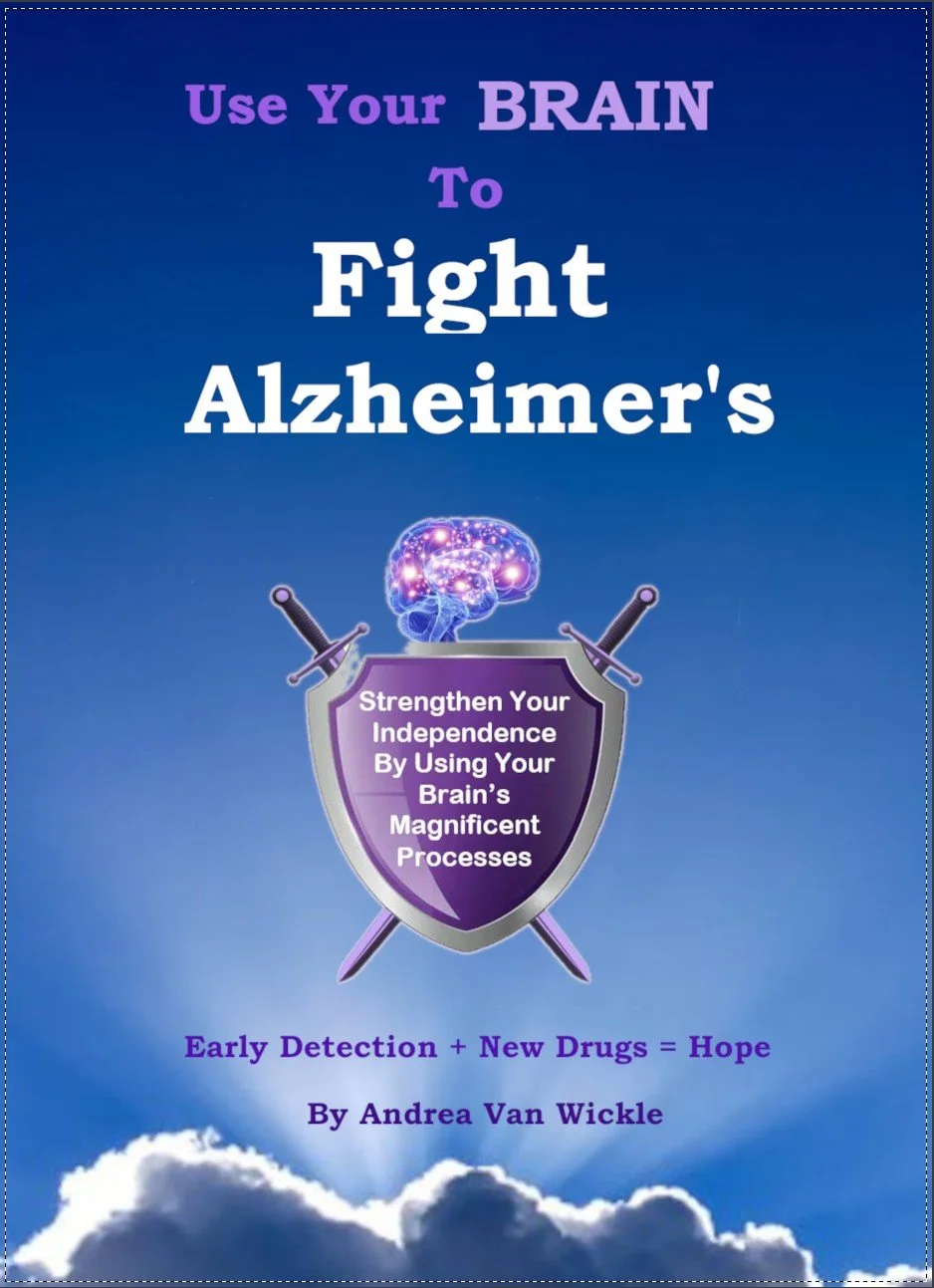
Use Your Brain to Fight Alzheimer’s
Early Detection +New Drugs = Hope
A new book by Andrea Van Wickle.
by Cheri Cabot
December 24, 2025
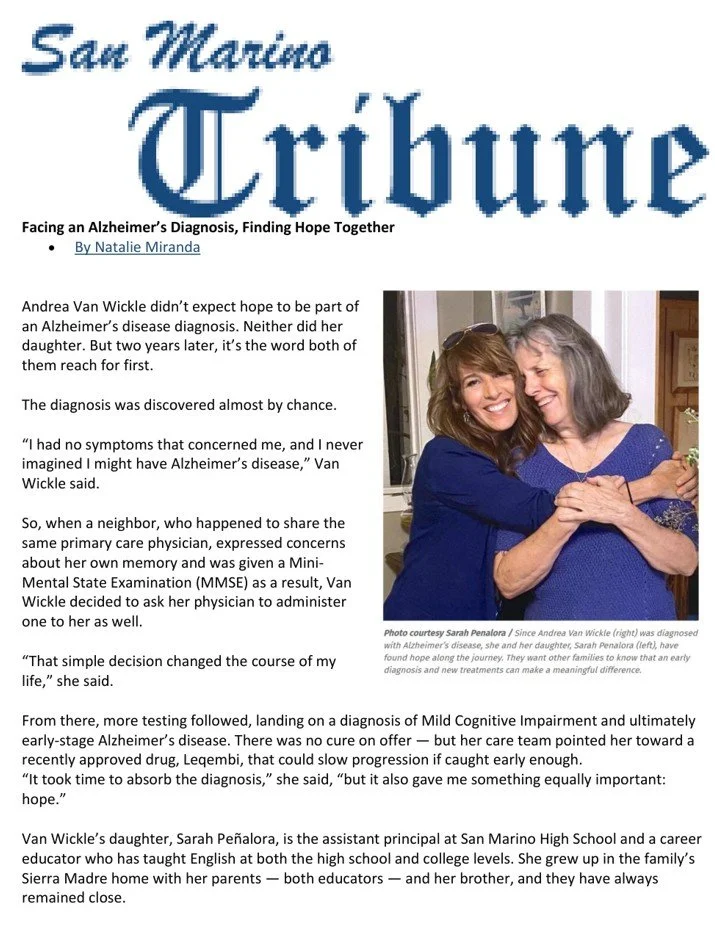
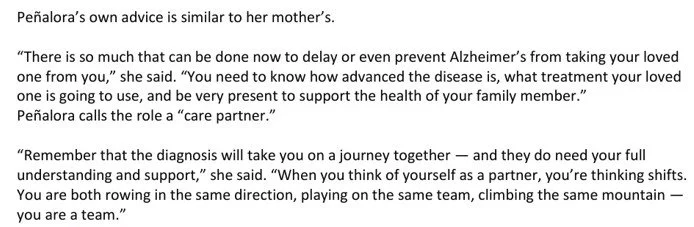
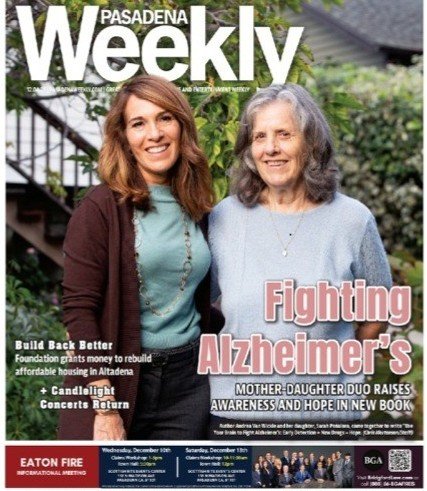
A mother-daughter duo in the San Gabriel Valley is raising awareness about early detection for Alzheimer’s disease, working together to create “Use Your Brain to Fight Alzheimer’s: Early Detection + New Drugs = Hope,” a book detailing both a personal journey and practical solutions for maintaining cognitive function.
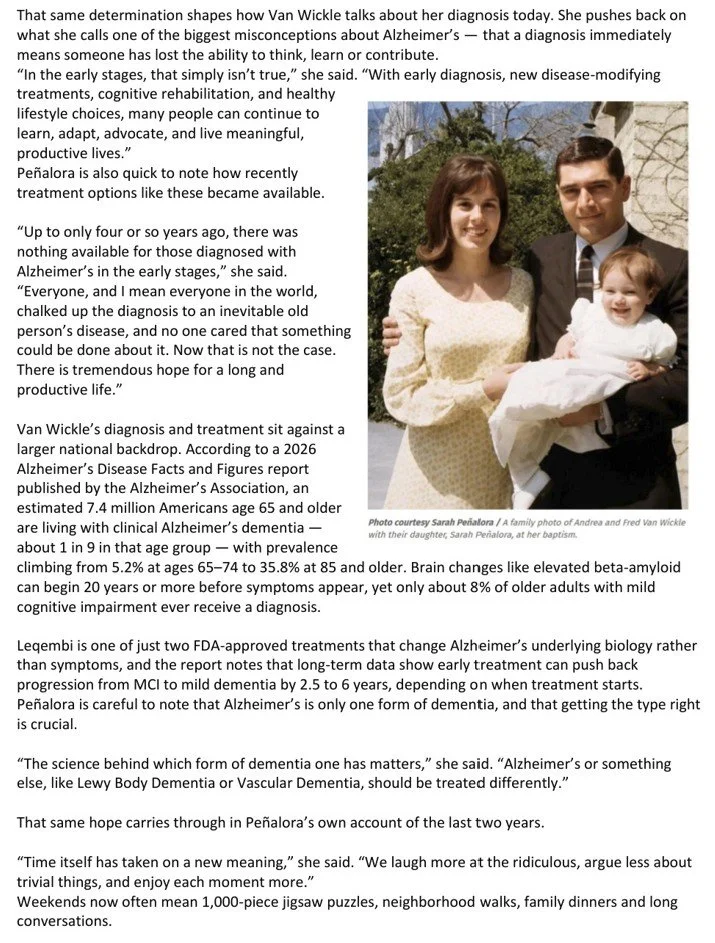
Author Andrea Van Wickle was diagnosed with Alzheimer’s disease two years ago. “Use Your Brain to Fight Alzheimer’s: Early Detection + New Drugs = Hope,” which was edited by Van Wickle’s daughter Sarah Penalora, details how Alzheimer’s begins, why early diagnosis matters and actionable steps that can protect and improve brain health, slowing the progression of memory loss.
“I wrote the book because I was really interested in everything I could find out about Alzheimer’s and how the brain works, and I wanted to make a record of it.” Van Wickle, a Sierra Madre resident, said “I spent a year gathering all the information that’s in the book, and then when I got it finished, I thought it would be really helpful for other people, as well as having the record myself that I can refer back to.”
Over seven million Americans are living with Alzheimer’s—about one in nine people age 65 and older. By 2050, the Alzheimer’s Association projects that number rise to nearly 13 million. The lifetime risk for Alzheimer’s at 45 years old is one in five for women and one in ten for men.
For Penalora, a Pasadena resident, helping make “Use Your Brain to Fight Alzheimer’s,” was both an informative and emotional journey. The “labor of love” with her mother showed he how crucial it is to get Alzheimer’s diagnosed early.
“It’s been a combination of jumping in to learn all we can, and then realizing that there’s so much hope to be had for keeping your parents longer, keep that relationship longer and extending a really healthy and fulfilling life,” she said. “My mom is super active. She hikes with a friend. They walk around town. She is writer, and she’s working on some other things right now. The hope is there. I would just keep reminding people to get an early diagnosis.”
However getting diagnosed early is not as simple as it should. Van Wickle herself did not believe she had Alzheimer’s, as she had no noticeable symptoms. It was only after a neighbor shared her experience in getting her memory tested by her doctor that Van Wickle considered exploring the possibility herself.
“I asked (my doctor) the next time I went in if I could have the test too.” Van Wickle said, “He gave me the test, and I didn’t do well. He called me back another three months later and did the same test. It was the MMSE test. He said that with (my) education, (I) should have a higher score.”
The Mini-Mental State Examination, or MMSE test, is a 10 minute screening tool for cognitive impairment. Scored out of 30, it assesses orientation, memory, language, visual-spatial skills and attention.
Van Wickle went to a neurologist, who confirmed she had Alzheimer’s. “Until I go the actual report from the neurologist, I was still thinking I didn’t have Alzheimer’s,” Van Wickle said. “It was just a fluke that I got tested and tested early. That’s the key word—early.”
One of the major things that must change in the medical industry, Van Wickle said, is normalizing early Alzheimer’s testing and conversations about the disease. The MMSE takes less than 20 minutes, she said, and it should be a part of a senior’s annual checkup.
“We check our bodies, but we don’t check our minds, and that’s just wrong”, Van Wickle said. “The brain is the most important organ in our body, and we aren’t checking it that way.”
Nearly three in five Americans say the would accept “moderate or very high levels of risk with taking medication to slow the progress of Alzheimer’s disease,” according to the Alzheimer’s Association.
Around the same time that Van Wickle was diagnosed with Alzheimer’s the FDA approved Leqembi, a medication that can slow the progression and offer hope to families battling Alzheimer’s disease. The monoclonal antibody removes amyloid plaques from the brain, and is administered via an IV infusion typically every two weeks.
“Leqembi coming out in 2023 and then have this diagnosis is giving more hope that there’s a way to stave off the effects of Alzheimer’s disease for a lot longer,” Penalora said.
Van Wickle has not had any side effects to Leqembi, though they can include headaches, coughs, and flu-like symptoms, as well as more serious cases, brain swelling.
Leqembi is showing results for Van Wickle, too.
“I’ve just had my 32nd infusion, and so it’s over a year, and I recently had a blood test. The original blood test that I took indicated I had Alzheimer’s was a blood test that tested amyloid plaques, and my readings were abnormal, indicating Alzheimer’s. This last test, those figures are all in the normal range, so that’s big for me.”
“Use Your Brain to Fight Alzheimer’s: Early Detection + New Drugs = Hope” is available on Amazon.
A new book by Andrea Van Wickle.
“You have Alzheimer’s, and there is no cure.”
Words that no one wants to hear, but it is estimated, according to the Fisher Center for Alzheimer’s Research Foundation, that 6.7 million Americans aged 65 and older have Alzheimer’s today, or about one new case every 65 seconds. That number is expected to rise to 13 million.
One of those 6.7 million is Andrea Van Wickle. She had no idea she was in the beginning stages of Alzheimer’s. Her good friend and neighbor, Alice Clark, had her memory checked and suggested Van Wickle do the same. It was a 20-minute test, primarily memory. Clark passed the test. Van Wickle did not.
“I didn’t realize I had a problem until I was fully tested,” Van Wickle said. “To my knowledge, I had no symptoms, no family history [of Alzheimer’s]. It was just a fluke.”
Van Wickle’s daughter, Sarah Penalora, said, “The only sign I could recognize was when she wanted to find a specific word and couldn’t access it, she would say ‘never mind.’ So, in my mind, I thought this is the culture of aging, we’re all aging, and memory loss, and a certain amount of dementia sets in.”
Alzheimer’s and dementia are words that get tossed around and can be confusing. What is the difference? The Alzheimer’s Association states, “In summary, dementia is an umbrella term that describes a collection of symptoms (cognitive, functional and behavioral) that are caused by specific diseases. Alzheimer’s disease is the most common disease that causes dementia.”
A few months later, Van Wickle took the test again and still didn’t do well. She was referred to Dr. Mikael, a Neuro-Rehabilitation Psychologist in Pasadena, who suggested more extensive testing. Testing, which took Van Wickle two days, three hours each day.
The tests covered general intellect, higher-level executive skills, language, attention/concentration, learning and memory, visual-spatial skills, motor and sensory skills and mood and personality.
Out of 65 test results, Van Wickle scored ‘Average to Exceptionally High’ on 63 of them. Of the remaining two, she scored ‘Below Average.’ Her low scores were on Logical Memory Recognition and the Rey-Osterrieth Figure Copy Test.
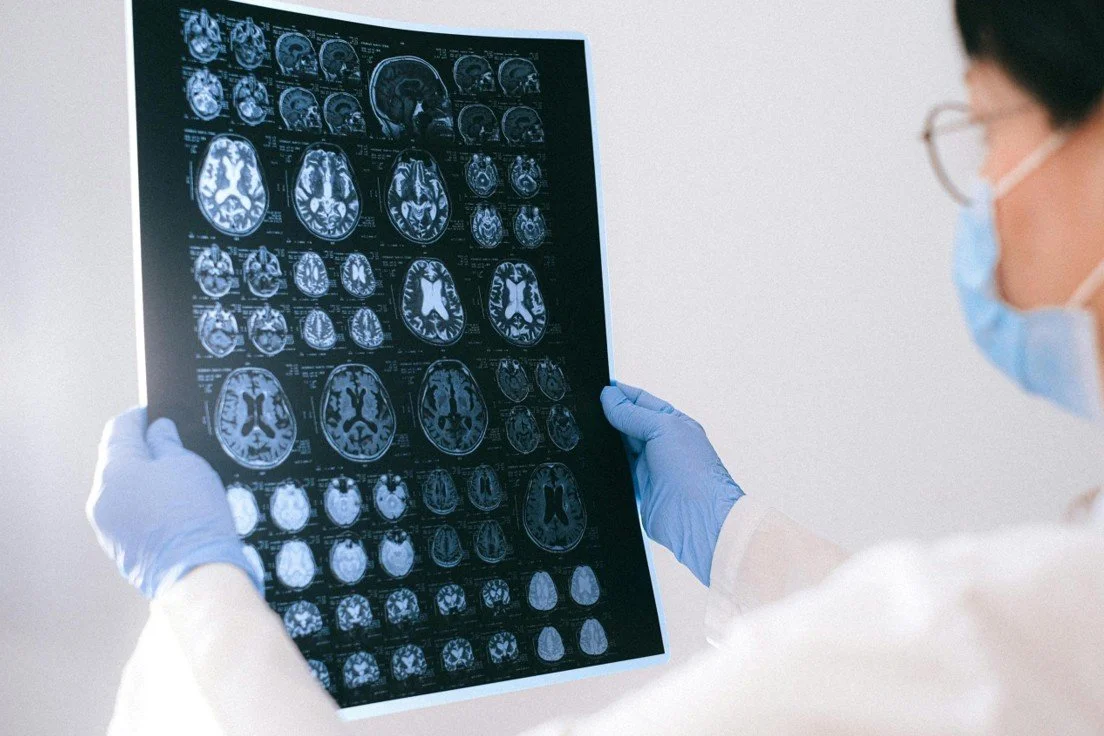
At this point, Van Wickle did not have a diagnosis, however after the testing, Dr. Mikael said, “there’s something here that should be looked at,” and referred Van Wickle see neurologist Dr. Frechette who conducted a CSF Blood Test, an Electroencephalogram (EEG), which examines the brain’s electrical activity, Magnetic Resonance Imaging (MRI) and an Amyloid Brain Scan (PET CT).
Van Wickle now had a diagnosis: “You have Alzheimer’s, and there is no cure.”
Moving forward after the diagnosis.
“My first reaction was to tell nobody,” Van Wickle said. But then, she told her daughter.
“When Mom was diagnosed, I just froze,” Penalora said, “What does it mean? What are we going to do?”
It was important for her to know what to expect, how the disease would affect her mother and also how she could care for her when that became necessary.
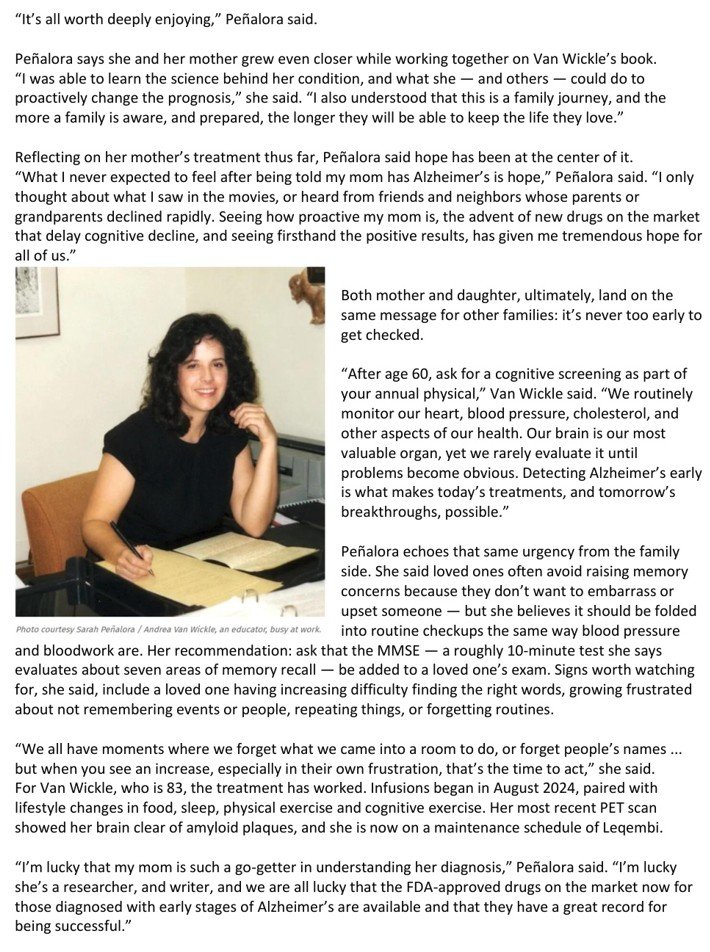
Once Van Wickle had the diagnosis, she went into overdrive to find out all she could about the disease. As a former teacher, corporate manager of an accounting firm, and a director of operations for a small business, she was always writing manuals and training others.
“I want to learn what the goal is. What are the processes, and how can you fix those processes? I want to know not only what happens, but why it happens,” Van Wickle explained.
She also needed to decide on a treatment plan. Because Van Wickle was in the early stages of Alzheimer’s, mainly mild cognitive impairment, she qualified for drugs that had recently been approved by the Food and Drug Administration (FDA). She needed to make a choice of drugs, so she did her research.
The two she looked into were Lequembi (lecanemab) and Kisunla (donanemab). Stanford Medicine gave a simple explanation of the drugs. Both are medications that help remove a protein called amyloid from the brain. This protein builds up in people with Alzheimer’s disease.
Van Wickle was fascinated. She wanted to know what is out there for the newly diagnosed. She started researching treatments.
“They don’t cure you,” Van Wickle stressed, “because there is no cure for Alzheimer’s, but they delay by attacking the amyloid plaques that are in your brain, causing the problems by killing neurons, each of which holds a bit of memory.”
It slows the process down. After considering the pros and cons and possible side effects, she chose Lequembi, which requires bi-monthly infusions and attacks beta-amyloid before and after plaques are formed. Van Wickle lives in Sierra Madre, California, and there is an infusion center in nearby Arcadia, so it is convenient.
Over the past year and a few months, Van Wickle has received 32 infusions. The results are astonishing! After completing the 32 infusions, she took another blood test, the same test taken at the time of her diagnosis. The test went from showing she had Alzheimer’s to normal.
“We were really lucky that the company [Lequembi] started to care about Alzheimer’s delay,” Penalora said. “What we can do to stay healthy longer, keep memory longer, and keep my mom around for longer, that’s the big deal for me. Making sure I get to hang out with her as long as possible.”
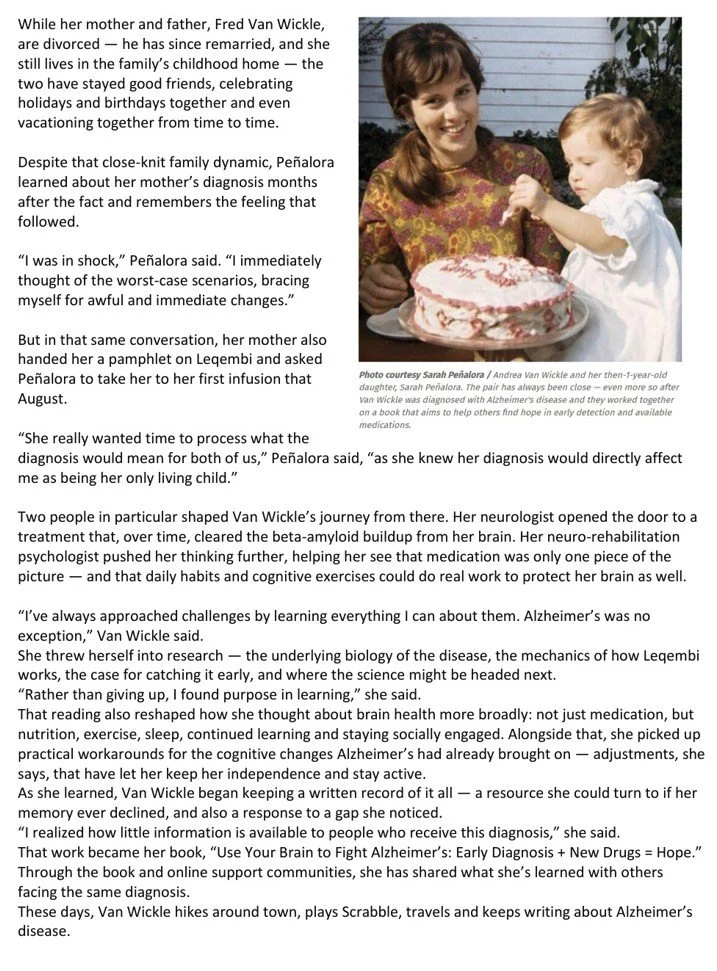
After doing so much research, Van Wickle decided to put it all to good use and write a book about what she learned and her experience dealing with the disease. Van Wickle wrote the book, and Penalora was her editor.
The result was “Use Your Brain to Fight Alzheimer’s: Early Detection + New Drugs = Hope.”
“It was a bonding thing,” Penalora said, “because we could argue about syntax and organization of information, but at the end of the day, I was able to follow the path of the way she was thinking. ‘Here’s my diagnosis, what do I do about it? What do I need to know?’ And her big research was ‘how does the brain work?’”
“People can have their own journey. I see a difference in confidence, because she [Van Wickle] knows everything that is happening now, what is eventually going to happen, but also what the medication can stave off and keep her as healthy as possible.”
The Alzheimer’s diagnosis and subsequent book was a journey the two women decided to travel together.
According to Penalora, working together was very therapeutic. “Every weekend I would come over to Mom’s [Van Wickle] house and go through a new chapter, and we would disagree, agree, laugh, and it was really wonderful. A good thing. It was just me and my mom, and it just felt really good. And then, I would know exactly how she was moving through the diagnosis. To what the brain does, to what we can do now.”
“Think about it,” Van Wickle said, “we all want to know what our end date is going to be like. What’s my end date? How’s it going to look? And now, I have an idea of what it might look like, and I have plans for it.”
‘You need to take the fear factor out and put in the hope,’ Van Wickle said.
Both women stress that an Alzheimer’s diagnosis is nothing to be afraid of. There is no pain. You don’t feel sick, and you don’t realize it’s happening.
Van Wickle takes her own advice, which she learned from her doctors and all her research. She believes it is extremely important to use your brain, improve your diet and exercise. At age 81, she is still very active, hiking/walking three days a week with her friend, Joyce, and sometimes her daughter. She also enjoys birdwatching, playing Scrabble, and reading. She has changed to primarily a Mediterranean diet. For now, she is still receiving Lequembi infusions.
The book, vetted by two PhD’s, Dr. Patrick Manning (PhD), noted historian, and emeritus professor at Pittsburgh University (whose wife has Alzheimer’s) and Dr. Alan Jones (PhD), emeritus professor of neurology and other sciences at Pitzer College, is a comprehensive guide for anyone diagnosed with early onset Alzheimer’s and their family. It takes a deep dive into everything from diagnosis and tests to drugs, the biology of the disease, brain health, memory, and things to consider as the disease worsens.
Two doctors recommend the book to their patients, Dr. Eric Frechette (MD), doctor of neurology and Dr. Mona Mikael (PsyD), a doctor of neuro-rehabilitation psychology.
The Alzheimer’s test is available to anyone, but doctors do not suggest it. Most Alzheimer’s professionals adhere to 2025 clinical guidelines from the Alzheimer’s Association, which recommend that only people with symptoms be tested. The reason: “There is no proven medical treatment for AD (Alzheimer’s Disease) before people have symptoms.
The book, “Use Your Brain to Fight Alzheimer’s. Early Detection +New Drugs = Hope,” by Andrea Van Wickle, can be purchased on Amazon.