

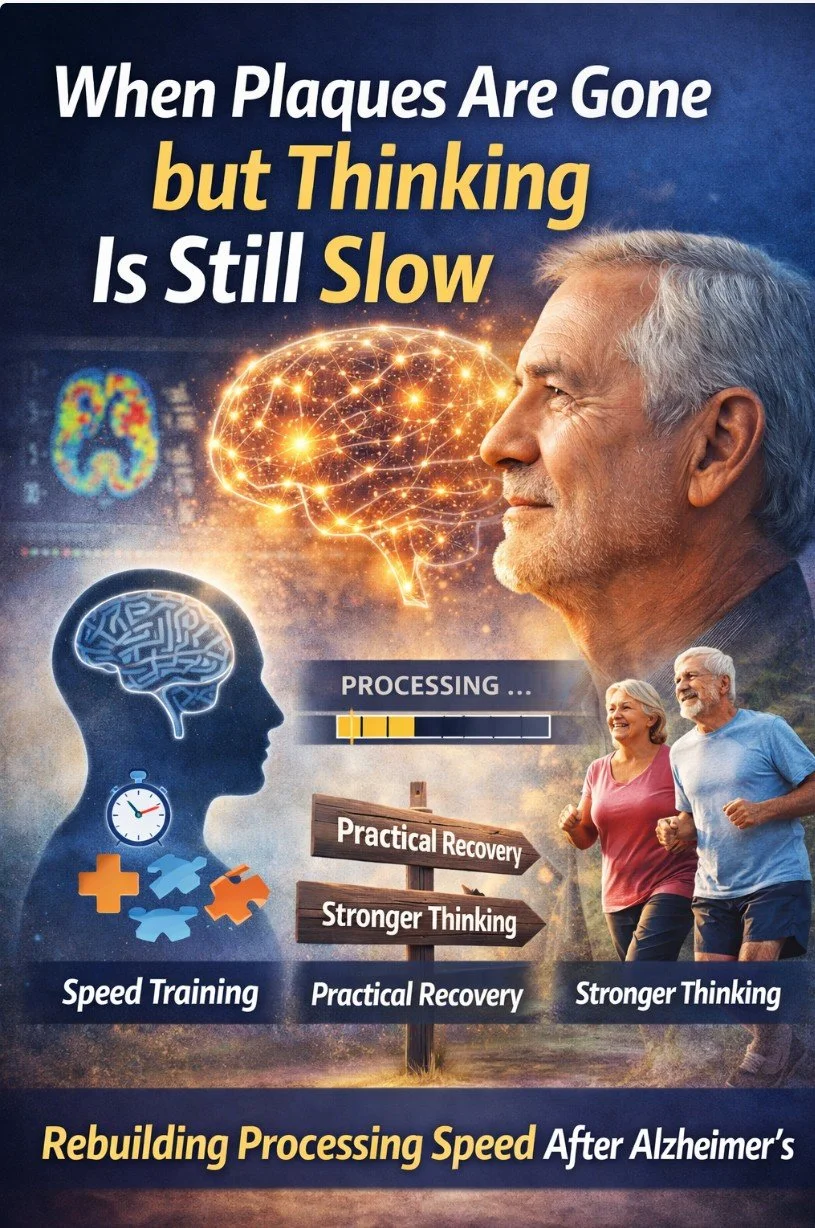
Processing Speed & Alzheimer’s: Repairing What Remains
Now that treatment with Leqembi has, at least for now, cleared amyloid plaques from my brain, I’ve noticed something important: I am still dealing with slow processing speed.
A recent experience made this very clear. I was helping my brother renew his driver’s license. He doesn’t use a computer, so I had previously set up his DMV account using my email address. When it came time to renew, California required that everything be completed online before scheduling an appointment.
I logged in, entered my email, and tried what I believed was the correct password. It didn’t work. I tried again. And again. After several failed attempts, I assumed something was wrong with the account and spent nearly two hours creating a workaround, setting up a new account with a different email address and overriding the original one.
Only after all of that did the mistake become obvious:
I had been entering the wrong password, the account password instead of my email password.
This wasn’t a memory problem. It was a processing speed problem. With faster processing, I likely would have caught the error quickly. Instead, my brain stayed stuck on the wrong track.
That experience led me to an important realization:
Removing plaques is not the same as restoring function.
So I began looking for ways to improve processing speed and turned to ChatGPT. The strategies I found closely matched what I’ve learned about rehabilitating mild cognitive impairment (MCI):
the brain can still adapt, relearn, and improve.


Where Did My Short-Term Memory Go?
I’ve reached a point where my Alzheimer’s has slowed down enough that I can start to see more clearly what it has left behind. One problem stands out above all the others: my short-term or working memory.
It shows up in the smallest, most frustrating ways.
Did I already brush my teeth? Why am I opening this drawer? Why did I walk into this room?
What did I just do? A thought to do something just flitted by, where did it go?
These moments aren’t occasional they happen throughout my day. And they force me to confront an uncomfortable truth: something in my brain has changed permanently.
So instead of asking “Why is this happening?”, I’ve started asking a better question:
“What can I do about it?”
The Hidden Memory System That Can Help Fight Alzheimer's
Once we’ve started Leqembi or Kisunla we are anxious to see improvement in our AD symptoms and many of us do see improvement. That improvement is not because memory has been restored, it is because with mild cognitive impairment our brains can still relearn and to some extent starts doing that when we shift our thoughts to fixing what we have lost. We can and should begin and continue to repair ADs damage to prolong our independence as long as possible. I’ve written an article that I think may help you understand the power than only you have to repair what has been lost.