
Newly Diagnosed with Alzheimer’s? A Guide to Your Treatment Options, Risks and Costs
Every day, hundreds of families hear the same heartbreaking words: “It’s Alzheimer’s.” For many, that moment divides life into before and after.
When I was diagnosed early, I counted myself among the lucky ones. Early detection gave me something that generations before me did not have: a window of choice and a reason to hope.
If you have already been diagnosed with mild cognitive impairment (MCI) due to Alzheimer’s disease or early Alzheimer’s dementia, you may now be facing an important decision: whether to begin treatment and, if so, which option is right for you. Today, Leqembi and Kisunla are FDA-approved anti-amyloid treatments that can slow the progression of early symptomatic Alzheimer’s disease. Leqembi is available as an intravenous infusion and as a subcutaneous injection called IQLIK.
But having choices also means having decisions to make, often within a relatively short period. As you discuss treatment with your neurologist, you may have many questions: Which treatment best fits my circumstances? How does each drug target amyloid in the brain? What are the risks, including ARIA (amyloid-related imaging abnormalities)? How often will I need treatment and MRI monitoring? What happens after the initial treatment period? Is maintenance therapy an option? And, importantly, what will it cost?
These are not simple decisions. My goal is to help make that process easier by explaining the basic differences between Leqembi and Kisunla, what they target, how they are given, how treatment decisions are made, and what you need to know about maintenance and cost.
An Alzheimer’s diagnosis is life-changing. But today, it does not have to mean that you are without choices.
These drugs are designed to remove amyloid from the brain by targeting forms of beta-amyloid that contribute to the formation of amyloid plaques. To understand how these treatments work, let’s first look at how amyloid plaques form in the brain.
How Beta-Amyloid Builds Up in Alzheimer’s
Your brain naturally makes a protein fragment called beta-amyloid. Normally, your brain clears it away. But in Alzheimer’s, this cleanup process becomes less effective, and some beta-amyloid can gradually build up.
Beta-amyloid can build up in stages: One molecule → small clusters → larger fibers → plaques. Not every beta-amyloid molecule follows this exact path. The process is more complex, and the formation of plaques depends on how beta-amyloid molecules assemble, accumulate, and are cleared from the brain.
A single beta-amyloid molecule is called a monomer. Two can join to form a dimer. Several molecules can then form oligomers, tiny clusters that are now believed to be among the earliest and potentially most harmful forms of beta-amyloid.
These oligomers can grow into protofibrils that are also toxic, then fibrils, and eventually collect into the larger amyloid plaques that can be seen on an amyloid PET scan.
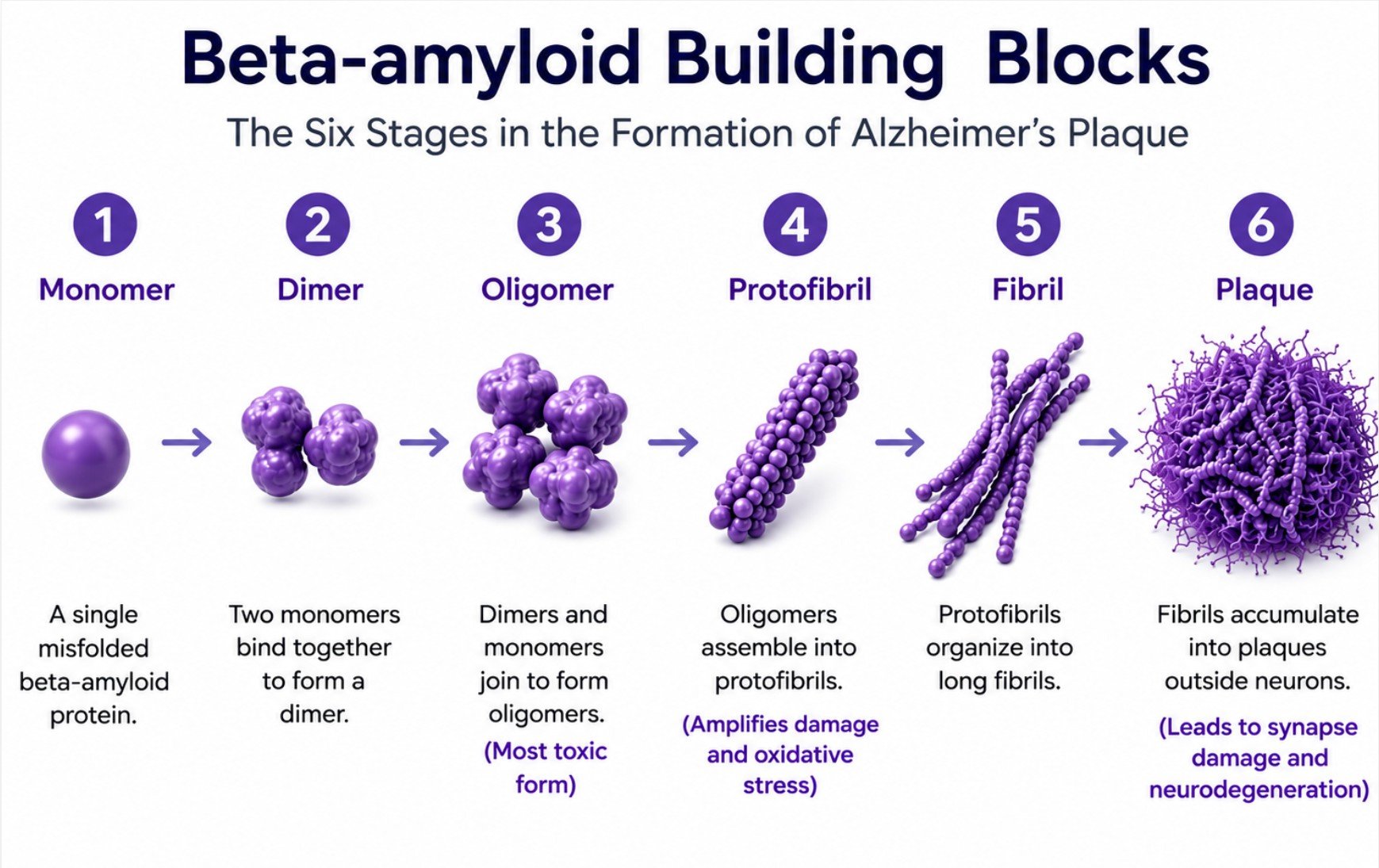
The important point is that plaques are not necessarily where the story begins. They are the visible end result of a process that may have been developing for years. Scientists now believe that some of the smaller forms of beta-amyloid, particularly oligomers and protofibrils may damage brain cells and their connections before large plaques become visible on a brain scan.
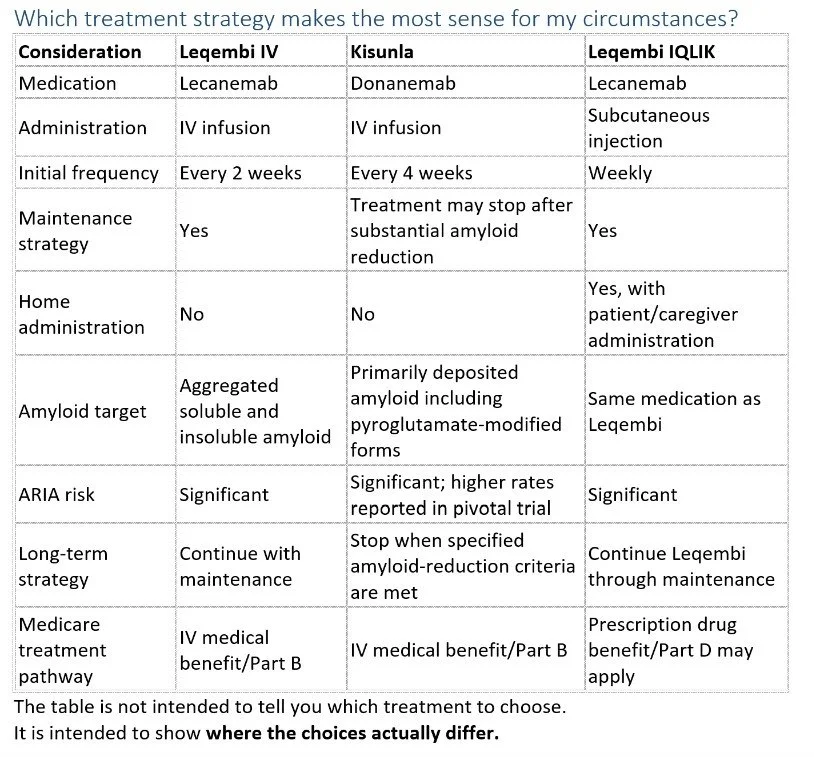
Which treatment approach fits my circumstances?
Leqembi IV, Leqembi IQLIK and Kisunla are designed to target those destructive amyloid proteins. These monoclonal antibodies bind targeted forms of amyloid and facilitate its removal through biological clearance processes involving immune cells and other mechanisms. But they differ in how, and when, they attack.
What do they target?
Kisunla zeroes in on a particularly toxic form of beta-amyloid called N-truncated pyroglutamate Aβ (N3pE-Aβ), a potent “seed” that can accelerate plaque growth.
Leqembi, on the other hand, targets earlier and smaller forms of beta-amyloid, oligomers and protofibrils, the building blocks that eventually harden into plaque, it also targets plaques that have already formed. Leqembi targets both the small clusters of beta-amyloid that can grow into plaques and the plaques that have already formed. This helps the brain clear away existing amyloid buildup and reduce the amount that remains.
How often is treatment given and what is the dosage?
Leqembi infusions are every 2 weeks; the dosage is 10 mg per kilogram of your body weight.
Leqembi IQLIK 500 mg weekly for the initial treatment.
Kisunla infusions are every 4 weeks; same dosage amount for all patients; Infusion 1; 350 mgs; Infusion 2, 700 mgs; Infusion 3, 1,050 mgs; remaining infusions 1,400 mgs. (FDA, 2025) (FDA, 2026)
How long is the initial treatment?
This creates one of the most important practical differences between the two treatments: Leqembi is currently designed around continued treatment and maintenance. Kisunla is designed around the possibility of stopping treatment after substantial amyloid clearance.
Scientists are still studying how long the benefits last after either drug is stopped, whether amyloid will return, and whether some patients can safely stop treatment without needing it again.
Kisunla’s treatment may be stopped after amyloid plaque has been reduced to specified low levels on amyloid PET imaging. The FDA prescribing information specifically describes stopping treatment based on reduction of amyloid plaques to minimal levels on PET imaging.
This is what the Kisunla website states regarding the ending of treatment:
“It’s possible to complete a treatment course with Kisunla in as early as 6 months. Your doctor may consider completing your Kisunla treatment course if your amyloid plaque levels are reduced to minimal levels (Amyloid levels measured by PET scan).
In a clinical study, 69% of people were able to complete treatment course with Kisunla at 18 months, 47% at 12 months, and 17% at 6 months if their amyloid plaques were reduced to a predefined level.
PET scans were used to determine amyloid levels in the study.
Amyloid PET values may increase after completing treatment course with Kisunla. There are no data beyond the 18-month duration of the study to guide whether additional dosing with Kisunla may be needed for longer-term clinical benefit.
The long-term clinical benefit of Kisunla after completing treatment course has not been studied.
No notable amyloid plaque reaccumulation was detected 1 year after completing the treatment course with Kisunla. In a clinical study, those who completed their treatment course with Kisunla did not show any notable plaque reaccumulation after 1 year.
Those who had no notable amyloid plaque reaccumulation 1 year after completing treatment were part of a small subset of the overall population and were less progressed in their disease.
A separate analysis showed that low amounts of amyloid plaque may reaccumulate per year after completing treatment course. The duration of efficacy beyond 76 weeks has not been established, as there are no data to inform whether additional dosing with Kisunla may be needed for longer-term clinical benefit.” (Lilly, 2026)
What is maintenance?
Leqembi has a different approach. After 18 months of treatment and a negative amyloid PET scan, patients may have the option of moving to maintenance treatment.
Leqembi offers continued treatment even after amyloid plaques have been cleared because the brain continues to produce amyloid, and plaques may gradually build up again when treatment stops. In addition, Alzheimer's disease involves more than amyloid. Tau tangles and damage to brain cells may remain even when an amyloid PET scan shows little or no plaque.
The maintenance options include:
· Leqembi IV infusion once every 4 weeks; dosage 10 mg/kg of weight
LEQEMBI IQLIK at home injections; dosage 360 mg once every week
continuing the original treatment schedule when appropriate.
The FDA-approved maintenance strategy is intended to continue treatment after the initial period rather than automatically stopping once amyloid has been substantially reduced. (FDA, 2026)
IQLIK: A Different Way to Receive Leqembi
IQLIK can initially sound like a third anti-amyloid drug. It isn't.
The choice between IV Leqembi and IQLIK is therefore not primarily a choice between two different Alzheimer's medicines. Leqembi infusions are delivered at an infusion center. IQLIK is a prescription delivered to your home and is administered. LEQEMBI IQLIK is injected under the skin using a prefilled autoinjector pen. It is not injected into a vein like the original Leqembi infusion.
Being able to self-administer may matter enormously to someone who lives far from an infusion center, has difficulty arranging transportation, dislikes intravenous treatment, or simply prefers the convenience of home administration.
On the other hand, home treatment requires the patient or caregiver to be comfortable with the injection process and to maintain a reliable weekly schedule.
ARIA Risk
One of the first things many people learn after being diagnosed with early-stage Alzheimer’s is that new treatments such as Leqembi (lecanemab) and Kisunla (donanemab) may slow the progression of the disease. But before treatment begins, another subject is introduced: ARIA, a potential side effect associated with these anti-amyloid drugs.
For many people, this can be frightening because one part of the ARIA risk assessment involves an inherited gene called APOE and two of its alleles. Understanding what the APOE test actually tells you and what it does not tell you can make this risk easier to understand.
What is an allele?
An allele is simply a different version of a gene.
You inherit one copy of the APOE gene from each parent. There are three major APOE alleles: ε2, ε3, and ε4. Because you inherit one allele from each parent, you will have two APOE alleles, creating one of six possible combinations.
What does your APOE combination mean?
Risk
· ε2/ε2 Lowest Does not provide complete protection
· ε2/ε3 Lower Lower than ε3/ε3
· ε2/ε4 Intermediate Complicated
· ε3/ε3 Average Generally considered neutral
· ε3/ε4 Higher Commonly estimated about 3 times the risk of ε3/ε3
· ε4/ε4 Highest Commonly estimated about 8–12 times the risk of ε3/ε3.
These are population-level associations, not individual predictions. For Alzheimer's disease, APOE ε4 is a risk factor not a cause and not a prediction. Having an ε4 allele does not mean that a person will develop Alzheimer's disease or ARIA.
It is important to keep the terminology straight:
APOE = the gene
APOE ε2, ε3, ε4 = the alleles, or versions, of the gene
apoE2, apoE3, apoE4 = the proteins produced from those alleles
Why is ε4 different?
The three APOE alleles produce slightly different forms of the apoE protein. ApoE normally helps transport and recycle fats in the brain and interacts with amyloid, brain immune cells, and blood vessels.
The difference between apoE3 and apoE4 is remarkably small. At one position in the 299-amino-acid protein, apoE3 has the amino acid cysteine, while apoE4 has arginine.
That single change can alter how the protein behaves and how it interacts with other molecules.
But again, an APOE result describes a genetic risk factor. It does not tell you whether you personally will develop Alzheimer's disease or ARIA.
What is ARIA?
ARIA stands for amyloid-related imaging abnormalities. It is a potential side effect of anti-amyloid treatments such as Leqembi and Kisunla.
Leqembi and Kisunla are designed to remove beta-amyloid from the brain. But amyloid can also accumulate in the walls of small blood vessels. This is particularly important because those vessels may already be fragile.
When treatment removes amyloid associated with these blood vessels, the vessels may temporarily become more permeable. Fluid or small amounts of blood may leak from them, producing the two major forms of ARIA:
ARIA-E — edema, or swelling/fluid in or around brain tissue
ARIA-H — hemosiderin, or blood products left behind by small areas of bleeding
A simple way to picture this is to think of the brain's small blood vessels as old pipes with buildup in their walls. If the pipes are already fragile, removing some of the buildup can temporarily disturb the pipe’s wall and make it more likely to leak.
APOE ε4 can be thought of as increasing the likelihood—not guaranteeing—that more amyloid is present in these vessel walls. This helps explain why people carrying ε4, particularly those with two copies (ε4/ε4), have a higher risk of ARIA during anti-amyloid treatment.
ARIA is called an imaging abnormality because it is usually detected on an MRI, sometimes before a person notices any symptoms.
What does ARIA-E look like?
ARIA-E involves fluid leaking from small blood vessels and producing swelling or increased fluid in the brain.
Possible symptoms include:
headache
confusion
dizziness
nausea
visual disturbances
difficulty walking or coordination problems
seizures in more serious cases
Many cases of ARIA-E cause no symptoms and are discovered during scheduled MRI monitoring.
What does ARIA-H look like?
ARIA-H involves blood products left behind when small blood vessels leak blood. It can include:
microhemorrhages — tiny areas of bleeding
superficial siderosis — blood products deposited along the surface of the brain
less commonly, larger areas of bleeding
Most ARIA is asymptomatic, but serious and, rarely, life-threatening hemorrhages can occur.
Why does APOE ε4 increase ARIA risk?
APOE ε4 matters in two different ways.
First, it is associated with an increased risk of developing Alzheimer's disease.
Second, people carrying APOE ε4—particularly people with two ε4 copies—have been found to have a higher risk of ARIA while receiving anti-amyloid treatment.
This is why your APOE result is relevant before beginning treatment with Leqembi or Kisunla.
Importantly, having APOE ε4 does not mean that you will develop ARIA. It means that your genetic background is one factor that your doctor considers when evaluating your treatment risk.
Can the ARIA risk of Leqembi and Kisunla be compared?
The clinical trials do not allow us to make a direct, apples-to-apples comparison of ARIA risk between Leqembi and Kisunla because the drugs have not been tested against each other in a head-to-head trial.
The newer Kisunla dosing regimen reported ARIA-E in 16% of patients and ARIA-H in 25%, compared with approximately 13% and 17%, respectively, in the pivotal Leqembi trial. These figures suggest that ARIA, particularly ARIA-H, may occur more frequently with the newer Kisunla regimen. However, the comparison is imperfect: the Kisunla study included only about 212 patients receiving the newer regimen and followed them for 12 months, while the pivotal Leqembi study included 898 treated patients followed for 18 months. These differences in study size and duration, along with differences in study design, mean the percentages cannot establish that Kisunla is inherently riskier than Leqembi. They do, however, provide useful context for a discussion with a neurologist about the potential risks of each treatment. (Christopher Chen, 2022) (FDA, 2025)
How do doctors monitor for ARIA?
Because ARIA is a known risk of both Leqembi and Kisunla, the FDA prescribing information specifies protocols for assessing and monitoring patients.
The APOE blood test and MRI monitoring provide different pieces of information:
APOE testing tells your doctor about an inherited genetic risk factor.
A baseline MRI looks for existing brain findings that may increase the risk of ARIA.
Follow-up MRIs look for evidence that ARIA has actually developed during treatment.
The genetic test cannot tell your doctor whether ARIA is present. The MRI cannot tell your doctor your genetic risk. They answer different questions and work together as part of the overall risk assessment.
LEQEMBI
Before starting Leqembi, the FDA prescribing information calls for a recent baseline brain MRI.
Under the current July 2026 labeling, additional MRIs are obtained after 1, 2, 3, and 6 months of treatment. The greatest vigilance is recommended during the first 14 weeks, when ARIA is more likely to occur.
If symptoms suggest ARIA at any time, an MRI may be performed.
KISUNLA
Kisunla also requires a recent baseline brain MRI before treatment begins.
The FDA labeling calls for additional MRIs before the 2nd, 3rd, 4th, and 7th infusions. Enhanced clinical vigilance is recommended during the first 24 weeks of treatment.
If symptoms suggest ARIA, the patient is evaluated and an MRI may be performed.
Why the MRI matters
An MRI provides something the APOE blood test cannot: evidence of what is actually happening in the brain.
The MRI can show:
ARIA-E — swelling or fluid in or around areas of the brain
ARIA-H — blood products, including microhemorrhages and superficial siderosis
MRI monitoring is important because ARIA can occur without symptoms.
If ARIA is found, the decision about whether to continue treatment, temporarily suspend treatment, or otherwise modify treatment depends on factors such as the type and severity of ARIA and whether the person has symptoms.
The ARIA Risk Picture
For someone considering Leqembi or Kisunla, think of ARIA risk as several pieces of information that fit together:
1. APOE genotype Does the person have zero, one, or two copies of APOE ε4?
2. Baseline MRI Are there already findings such as microhemorrhages or superficial siderosis that may increase ARIA risk?
3. Monitoring MRIs Does ARIA actually appear during treatment?
The FDA labeling for both drugs identifies APOE ε4 homozygosity (ε4/ε4) and certain pre-existing MRI findings as factors associated with increased ARIA risk.
This means that the APOE test is not a crystal ball. It is one piece of information that helps a doctor understand a person's risk before treatment. The baseline MRI provides another piece of information, and follow-up MRIs provide evidence about what is actually happening during treatment.
The Bottom Line
· Your APOE blood test estimates genetic risk.
· Your baseline MRI identifies important pre-existing brain findings.
· Your follow-up MRIs determine whether ARIA actually develops.
· Most importantly, an APOE ε4 result should never be interpreted by itself as a prediction that you will or will not develop ARIA. It is one part of an ongoing risk assessment designed to help you and your doctor make informed decisions and detect ARIA early if it occurs.
What Will My Treatment Costs Be?
Medicare Costs
Initial Treatment Costs
Medicare generally pays 80% of the Medicare-approved cost of covered Alzheimer's-related services under Part B, leaving the patient responsible for the remaining 20%. The amount patients pay out of pocket varies depending on their deductibles, supplemental insurance coverage, and whether the services they receive are covered by Medicare.
Medicare plan If you choose IQLIK
IQLIK is considered a drug because it is injected not infused. One is an infusion at a medical infusion center then other is a prescription that does not require a medical center.
I recently started on Leqembi maintenance and had to weigh the cost of remaining on infusions, which are covered by Medicare under Part B, against switching to IQLIK, which is covered through Medicare Part D. With Original Medicare, Part B generally pays 80% of the Medicare-approved amount for a covered treatment after the Part B deductible, while a Medicare Supplement (Medigap) policy may cover some or all of the remaining cost-sharing, depending on the plan. IQLIK is handled differently because it is covered through the Part D prescription drug benefit. Part D can be more complicated, with coverage and out-of-pocket costs depending on your individual drug plan. Each of us has to weigh our own circumstances and the benefits, costs, and convenience of each option. (Medicare, 2026) (Statement: Broader Medicare Coverage of Leqembi Available Following FDA Traditional Approval, 2023)
How does Medicare Part D (drugs) Work?
All of that leads directly to the next, and often most confusing, piece of the decision: how Medicare Part D actually works in practice. Unlike Part B, where your provider typically handles billing and Medicare pays its share automatically for treatments, Part D shifts payment for drugs to the responsibility of the patient, the prescribing specialist, and the specialty pharmacy coordinating the drug. Coverage depends on the specific drug plan you’ve chosen, its formulary, and how that plan manages high-cost specialty medications like IQLIK. Understanding this structure is essential, because it determines not only your out-of-pocket costs but also the exact steps required to get the medication approved, dispensed, and delivered.
How do you actually submit an IQLIK prescription to Medicare?
Submitting an IQLIK prescription (like Leqembi’s IQLIK) is not like sending a normal prescription to a pharmacy.
So how does it actually work?
If a drug is self-injected at home, it typically falls under Medicare Part D. If it is administered in a clinic or infusion center, it generally falls under Part B.
Because IQLIK is a home injection, it is typically processed through your Part D drug plan. Your doctor sends the prescription to a specialty pharmacy, which coordinates with your drug insurance plan to determine coverage, whether prior authorization is required, and your out-of-pocket cost.
Your doctor plays a key role here. They must send the prescription electronically or by fax to a specialty pharmacy (not a regular retail pharmacy like CVS). The prescription needs to include your diagnosis, the dosing schedule, and often supporting documentation. Your doctor's office and the specialty pharmacy generally work together to submit the necessary information.
Because IQLIK requires refrigeration and specialized handling, it is delivered through a specialty pharmacy rather than typically being picked up at an ordinary retail pharmacy. The specialty pharmacy coordinates insurance approval, delivery, and instructions for safe use at home
Once the plan makes its coverage decision, the pharmacy determines your share of the cost, which may include a deductible, copayment, or coinsurance. If the drug is expensive, your initial out-of-pocket payment may be substantial, and the pharmacy may require payment before shipping the medication.
This process can feel transactional, with approvals, billing, and payment happening in quick succession. The next question is how these payments are tracked over time and when financial relief begins. That depends on how Medicare Part D counts your eligible out-of-pocket spending toward its annual limit.
How Medicare $2,400 (2027) Out-of-pocket is Tracked
Every time a prescription is filled, the pharmacy (including specialty pharmacies) submits a claim electronically to your Medicare Part D plan. Your spending is tracked cumulatively. Your Part D plan keeps a running total of what you’ve paid. This is called your true out-of-pocket (TrOOP) cost.
Your drug plan insurance company reports data to Centers for Medicare & Medicaid Services, which sets the rules and ensures the cap is applied correctly.
How you can see your progress
You don’t have to guess—your plan keeps you updated:
Explanation of Benefits (EOB) statements (monthly)
Your plan’s website or app (often real-time tracking)
Customer service can tell you your current TrOOP total
What happens when you hit the cap
Once your tracked out-of-pocket spending for all of your prescriptions reaches the limit (about $2,400 starting in 2027): You pay $0 for covered Part D drugs for the rest of the calendar year. No forms. No extra steps. It switches automatically.
Things to check BEFORE Your First Prescription
MEDICARE PART D (DRUG)
You must be currently enrolled in Medicare Part D. Medicare Part D isn’t a card or a separate “government plan” by itself. Part D requires your selection and enrollment in a Medicare recognized separate Drug Plan Insurance Company. If you are not enrolled in a Medicare Part D prescription drug plan, your IQLIK prescription will not automatically have Part D coverage. You may have to pay the full cost of the medication unless you have other coverage or qualify for an exception or other assistance.
Ways to Check Part D
While Part B is printed on your social security card, Part D is not. With Medicare, enrolling in Part D (prescription drug coverage) is optional.
· If you enrolled in a Medicare and added an approved private insurance drug plan (e.g., Humana, Blue Shield) at that time, you have Part D.
· If you enrolled in a Medicare Advantage plan (Part C) with drug coverage, you have Part D.
· You might safely skip it if you already have: Employer or retiree drug coverage; VA drug benefits; TRICARE.
· If you enrolled, you should also have either a separate Part D plan ID card issued by your drug plan or a welcome letter or annual notice from the insurance company (like WellCare, AARP, etc.)
· Look at your monthly premiums, check your Social Security statement or bank account. If you see a separate premium for a drug plan, that’s Part D. It may be deducted from your Social Security check, or billed directly by the insurance company.
· You can also log into your Medicare account. Go to the official site: Centers for Medicare & Medicaid Services website (Medicare.gov) Once logged in, look under: “My Plans & Coverage”. It will clearly show whether you have Part D and the name of your drug plan. Call Medicare directly, 1-800-MEDICARE (1-800-633-4227). Ask: “Do I currently have a Part D prescription drug plan?” They can tell you instantly.
How to Enroll in Part D
If you did not enroll in Part D when you first applied for Medicare you can enroll during open enrollment October 15th to December 7th by selecting a drug plan. It will be effective on January 1.
Special Enrollment Period (SEP)
You can enroll outside the fall window if you have a qualifying event, such as: Losing other creditable drug coverage (like employer or VA coverage); Moving out of your plan’s service area; Qualifying for Extra Help (low-income subsidy).
IQLIK MUST BE ON THE DRUG PLAN’S FORMULARY
The specialty pharmacy will deny your prescription if your drug plan does not have IQLIK listed on their formulary. It doesn’t matter if the co-pay is 100%, the drug just has to appear on their list of drugs available to their subscribers.
How to Check Your Drug Plan for IQLIK
Call your drug company and ask if IQLIK is on your plan.
Checking to see if your drug plan covers IQLIK can be challenging. Another method is to check to see if your drug plan covers IQLIK is via medicare.gov.
IQLIK Is Not on Your Drug Plan’s Formulary
If your Medicare Part D plan does not list IQLIK on its formulary, you may have two options:
Option 1: Request a formulary exception.
Ask your neurologist to contact your Part D plan about requesting an exception to cover IQLIK. Your doctor must provide supporting information explaining why the medication is medically necessary for you. The plan will review the request under Medicare's rules. Approval is not guaranteed.
Option 2: Consider changing your drug plan.
If an exception is denied or is not a suitable option, you may consider switching to a Part D plan that covers IQLIK during an eligible enrollment period. For many people, Medicare Open Enrollment runs from October 15 through December 7, with coverage under the new plan beginning January 1. However, other enrollment opportunities may apply to some individuals.
Before making a change, confirm that the new plan covers Leqembi IQLIK and ask about your expected out-of-pocket costs. Do not discontinue your current treatment without discussing the timing and alternatives with your neurologist.
How to Request a Formulary Exception
Even if IQLIK is not listed on your plan's formulary, your prescriber can ask the plan to make an exception based on medical necessity. The plan evaluates the request and determines whether it meets Medicare's requirements.
Some healthcare providers may be less familiar with the exceptions process, so it may help to bring this information to your neurologist's office. For official guidance, see the Centers for Medicare & Medicaid Services (CMS): Medicare Part D Exceptions.
https://www.cms.gov/medicare/appeals-grievances/prescription-drug/exceptions
No Medicare? Options to Consider
If you are younger than Medicare eligibility age, the cost of an anti-amyloid treatment can be more difficult to predict. Private health insurance plans. including employer-sponsored plans, individual plans, HMOs, and integrated healthcare systems such as Kaiser Permanente make their own coverage and cost-sharing decisions. The same insurance company can have different rules for different plans.
If you are considering an anti-amyloid treatment, ask your insurance company specifically about all of the treatment options your doctor is considering: IV Leqembi, Leqembi IQLIK, and Kisunla.
IV Leqembi and Kisunla are administered by healthcare professionals and are generally handled through the medical benefit. IQLIK is generally handled through the pharmacy benefit, although the way it is processed can vary by insurance plan.
Before choosing a health plan or beginning treatment, ask:
• Is Leqembi IV covered under this plan?
• Is Leqembi IQLIK covered under this plan?
• Is Kisunla covered under this plan?
• Does the treatment require prior authorization?
• What diagnostic requirements must I meet?
• What will my deductible, copayment, or coinsurance be?
• Is there a separate charge for the infusion facility or administration of the drug?
• What will I pay for the required MRI scans and other monitoring?
• Is there a maximum annual out-of-pocket amount?
• Must I use a particular infusion center, specialty pharmacy, or healthcare system?
• Is the treatment covered only when provided by a particular network of doctors or facilities?
These questions are important because two people with private insurance can have very different costs even when they have the same insurance company.
Are there drug cost assistance programs?
Manufacturer assistance programs may also reduce costs for people with qualifying commercial insurance.
Lilly
Lilly currently has a commercial-plan coverage lookup tool that lets a provider investigate coverage by payer and specific policy. Lilly's Support Services can also conduct a benefits investigation and provide the patient and doctor's office with a Summary of Benefits, including information intended to identify the patient's lowest possible out-of-pocket cost. https://www.lilly.com/hcp/product/kisunla/savings-support/coverage-savings
For commercially insured patients, Lilly also currently has a Kisunla Savings Card. Eligible patients may pay as little as $0 per infusion, subject to eligibility, monthly/annual limits and program terms. The current program has an annual savings maximum of $10,600 and does not cover the separate costs of the infusion procedure or other healthcare services. https://www.lilly.com/hcp/product/kisunla/savings-support/coverage-savings
That last distinction is important. A $0 drug copay does not necessarily mean a $0 treatment. The patient could still have costs associated with the infusion facility, administration, MRI monitoring, physician visits, etc. (Lilly, 2026)
And Kisunla has another cost consideration. Unlike Leqembi, Kisunla may not necessarily be a lifelong monthly treatment. Its FDA-approved labeling permits the physician to consider stopping treatment after amyloid plaques have been reduced to minimal levels, as determined by amyloid PET. Therefore, the total cost can depend on how long the person remains on treatment.
https://www.lilly.com/hcp/product/kisunla/savings-support/coverage-savings
Eisai
Eisai currently offers a LEQEMBI Copay Assistance Program for eligible people with private/commercial insurance that covers Leqembi. Eisai says it can provide up to $10,000 per calendar year toward eligible out-of-pocket costs for Leqembi, including deductibles, copays, and coinsurance. Eligible patients may pay as little as $0 for the covered Leqembi drug cost, although there can still be other expenses, including administration charges, and the program has eligibility requirements and limits.
https://www.eisaipatientsupport.com/patient/leqembi
(Eisai, 2026)
The best way to determine your actual cost is to have your doctor's office and insurance company verify coverage for each treatment you are considering. Ask for a written estimate of your expected out-of-pocket costs before starting treatment. Do not assume that because an insurance company covers one anti-amyloid treatment, it will cover another treatment in the same way.
What are my options?
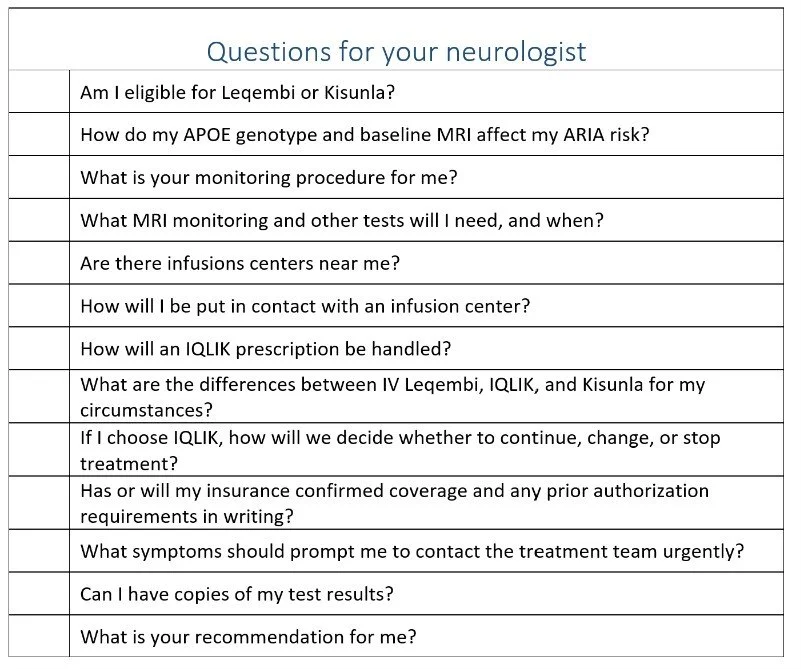
Questions for Your Neurologist
References
Alzheimer's Association. (2025, April 29). 2025 Alzheimer's disease facts and figures. Retrieved from Alzheimers Association: https://alz-journals.onlinelibrary.wiley.com/doi/10.1002/alz.70235
Alzheimer's Association. (2026). Is Alzheimer's Genetic? Retrieved from Alzheimer's Association: https://www.alz.org/alzheimers-dementia/what_is_alzheimers_%281%29/risk-factors/genetics
Chen, Y., He, Y., Han, J., Wei, W., & Chen, F. (2023, November 12). Blood-brain barrier dysfunction and Alzheimer’s disease: associations, pathogenic mechanisms, and therapeutic potential. Retrieved from Frontiers: https://www.frontiersin.org/journals/aging-neuroscience/articles/10.3389/fnagi.2023.1258640/full
Christopher Chen, B. B. (2022, November 29). Lecanemab in Early Alzheimer’s Disease. Retrieved from New England Journal of Medicine: https://www.nejm.org/doi/full/10.1056/NEJMoa2212948
Eisai. (2026). Leqembi Companion Program. Retrieved from Eisai Patient Support: https://www.eisaipatientsupport.com/patient/leqembi
FDA. (2023, July). Leqembi (lecanemab-irmb) injection for intravenous or subcutaneous use initial approval. Retrieved from FDA: https://www.accessdata.fda.gov/drugsatfda_docs/label/2026/761375s001lbl.pdf
FDA. (2024). Kisunla (donanemab-azbt) injections for intravenous use initial approval. Retrieved from FDA: https://www.accessdata.fda.gov/drugsatfda_docs/label/2025/761248s004lbl.pdf
FDA. (2025, July). KISUNLA (donanemab-azbt) injection, for intravenous use. Retrieved from FDA: https://www.accessdata.fda.gov/drugsatfda_docs/label/2025/761248s004lbl.pdf
FDA. (2026, July). LEQEMBI® (lecanemab-irmb) injection, for intravenous or subcutaneous. Retrieved from FDA: https://www.accessdata.fda.gov/drugsatfda_docs/label/2026/761375s001lbl.pdf
Fouquet, M., Besson, F. L., Gonneaud, J., La Joie, R., & Chételat, G. (2014, August 22). Imaging brain effects of APOE4 in cognitively normal individuals across the lifespan. Retrieved from Springer Nature Link: https://link.springer.com/article/10.1007/s11065-014-9263-8
Lilly. (2026). Completing Course of Treatment. Retrieved from kisunla.com: https://kisunla.lilly.com/treatment
Lilly. (2026). Coverage & patient support. Retrieved from Lilly.com: https://www.lilly.com/hcp/product/kisunla/savings-support/coverage-savings
Liu, C.-C., Kanekiyo, T., Xu, H., & Bu, G. (2013, January 8). Apolipoprotein E and Alzheimer disease: risk, mechanisms and therapy. Retrieved from Nature Reviews Neurology: https://www.nature.com/articles/nrneurol.2012.263
Mathys, H., & et al. (2019, May 1). Single-cell transcriptomic analysis of Alzheimer’s disease. Retrieved from nature: https://www.nature.com/articles/s41586-019-1195-2
Medicare. (2026). Monoclonal antibodies for treating early Alzheimer’s disease. Retrieved from Medicare.gov: https://www.medicare.gov/coverage/monoclonal-antibodies-for-treating-early-alzheimers-disease
Murdock, M. H., & Tsai, L.-H. (2023, July 2). Insights into Alzheimer’s disease from single-cell genomic approaches. Retrieved from Nature Neuroscience: https://www.nature.com/articles/s41593-022-01222-2
National Institute on Aging. (2023, March 1). Alzheimer's Disease Genetics Fact Sheet. Retrieved from National Institute on Aging: https://www.nia.nih.gov/health/alzheimers-causes-and-risk-factors/alzheimers-disease-genetics-fact-sheet
Roytman, M., & al, e. (2022, November 2). Amyloid-Related Imaging Abnormalities: An Update. Retrieved from National Library of Medicine: https://pubmed.ncbi.nlm.nih.gov/36321981/
Sperling, R., & al, e. (2012, March). Amyloid-related imaging abnormalities in patients with Alzheimer's disease treated with bapineuzumab: a retrospective analysis. Retrieved from The Lancet Neurology: https://www.thelancet.com/journals/laneur/article/PIIS1474-4422(12)70015-7/abstract
Statement: Broader Medicare Coverage of Leqembi Available Following FDA Traditional Approval. (2023, July 6). Retrieved from CMS.gov: https://www.cms.gov/newsroom/press-releases/statement-broader-medicare-coverage-leqembi-available-following-fda-traditional-approval
Yamazaki, Y., Zhao, N., Caulfield, T. R., Liu, C.-C., & Bu, G. (2019, July 31). Apolipoprotein E and Alzheimer disease: pathobiology and targeting strategies. Retrieved from Nature Reviews Neurology: https://www.nature.com/articles/s41582-019-0228-7