
Alzheimer’s Tau Tangle Challenges
Alzheimer's Tau Tangles: The Next Great Challenge After Amyloid Plaque
We are living in a remarkable time in Alzheimer's disease research. Tau tangles and beta-amyloid plaques are widely recognized as two of the defining features of Alzheimer's disease and are believed to play major roles in its development and progression, although scientists continue to investigate other factors that may contribute to the disease.
For the first time, treatments such as Leqembi can remove beta-amyloid plaques from the brain, including some of the toxic protofibrils that help form them. For many patients and families, these advances represent genuine hope that the course of Alzheimer's disease may finally be slowed.
Scientists now believe that plaques and tangles are closely connected. Beta-amyloid plaques typically appear first and may trigger biological changes that allow tau tangles to develop and spread. Many researchers describe amyloid as "switching on" the disease process, while tau becomes the primary driver of neuron damage and memory loss. In simple terms, plaques may start the fire, but tangles keep it burning.
Researchers have also found that treatments that reduce amyloid sometimes lower tau levels as well, suggesting that the two processes interact in ways that are still being unraveled. Yet amyloid plaques are only part of the story. Increasingly, scientific attention has turned toward tau tangles—abnormal protein structures that form inside neurons and gradually disrupt the brain's communication network from within.
Eighteen months of Leqembi treatments successfully cleared amyloid plaques from my own brain, a life-changing event. Yet tau tangles remained another part of the Alzheimer's challenge.
At first glance, tau tangles can seem overwhelming. Their biology is extraordinarily complex, and researchers are still uncovering how they form, spread through the brain, and resist the brain's efforts to remove them. It took me considerable time to sort through the many theories and discoveries. Eventually, however, I realized that the story begins not with the tangle itself, but with the normal tau protein quietly performing one of the most important maintenance jobs inside a healthy neuron. To understand how tau becomes part of the Alzheimer's process, we must first examine the healthy neuron and the essential role tau proteins play in keeping it functioning properly.
What is the function of normal tau protein?
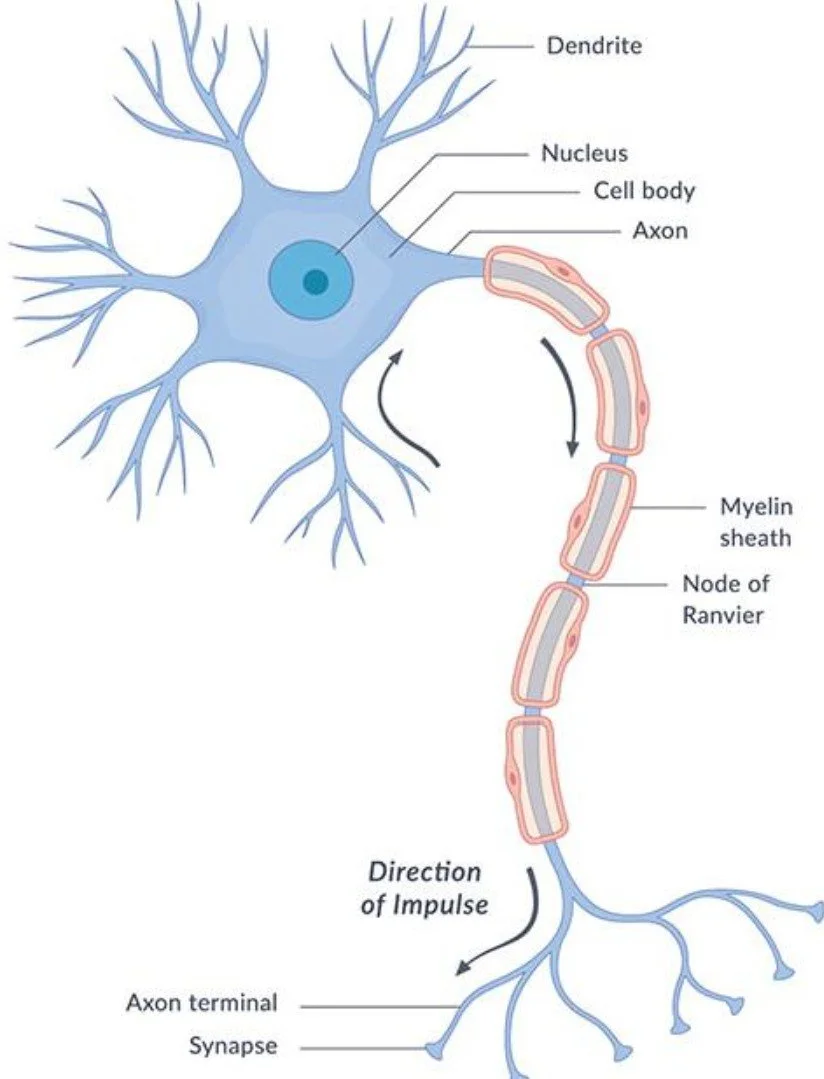
A healthy neuron is one of the brain’s most remarkable living cells. It constantly receives information, processes it, and sends messages to other neurons. To do this, the neuron must move enormous amounts of supplies, energy, and chemical signals from one part of the cell to another.
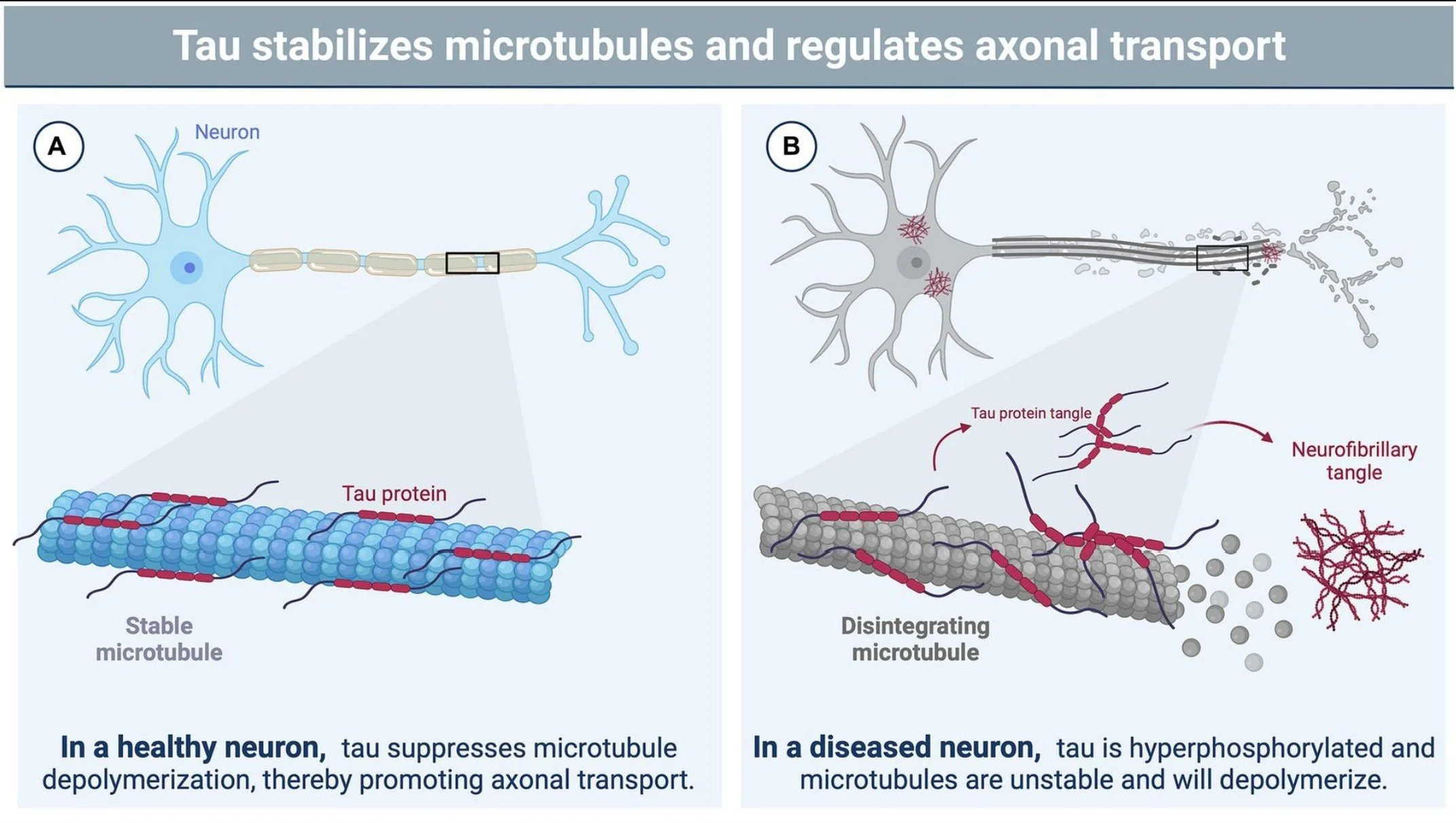
Inside the neuron is an intricate transportation system made of tiny hollow tubes called microtubules. These microtubules act like railroad tracks or highways running throughout the cell. Along these tracks travel nutrients, energy supplies, repair materials, and communication signals needed to keep the neuron alive and functioning properly.
Helping hold these tracks together is tau protein. Tau acts much like the railroad ties beneath train tracks. Its job is to stabilize the microtubules so the neuron’s transportation system remains organized and efficient. When tau is healthy, supplies move smoothly through the neuron, allowing brain cells to communicate and survive for decades.
Tau protein’s helper
Tau does not work alone. Attached to tau are tiny chemical helpers called phosphate groups. These phosphate groups act like small switches that control how tightly tau grips the microtubules. In healthy neurons, only a few phosphate groups attach at carefully controlled locations. This process, called phosphorylation, helps keep the system balanced, stable enough to hold the tracks together, but flexible enough for cargo to move freely.
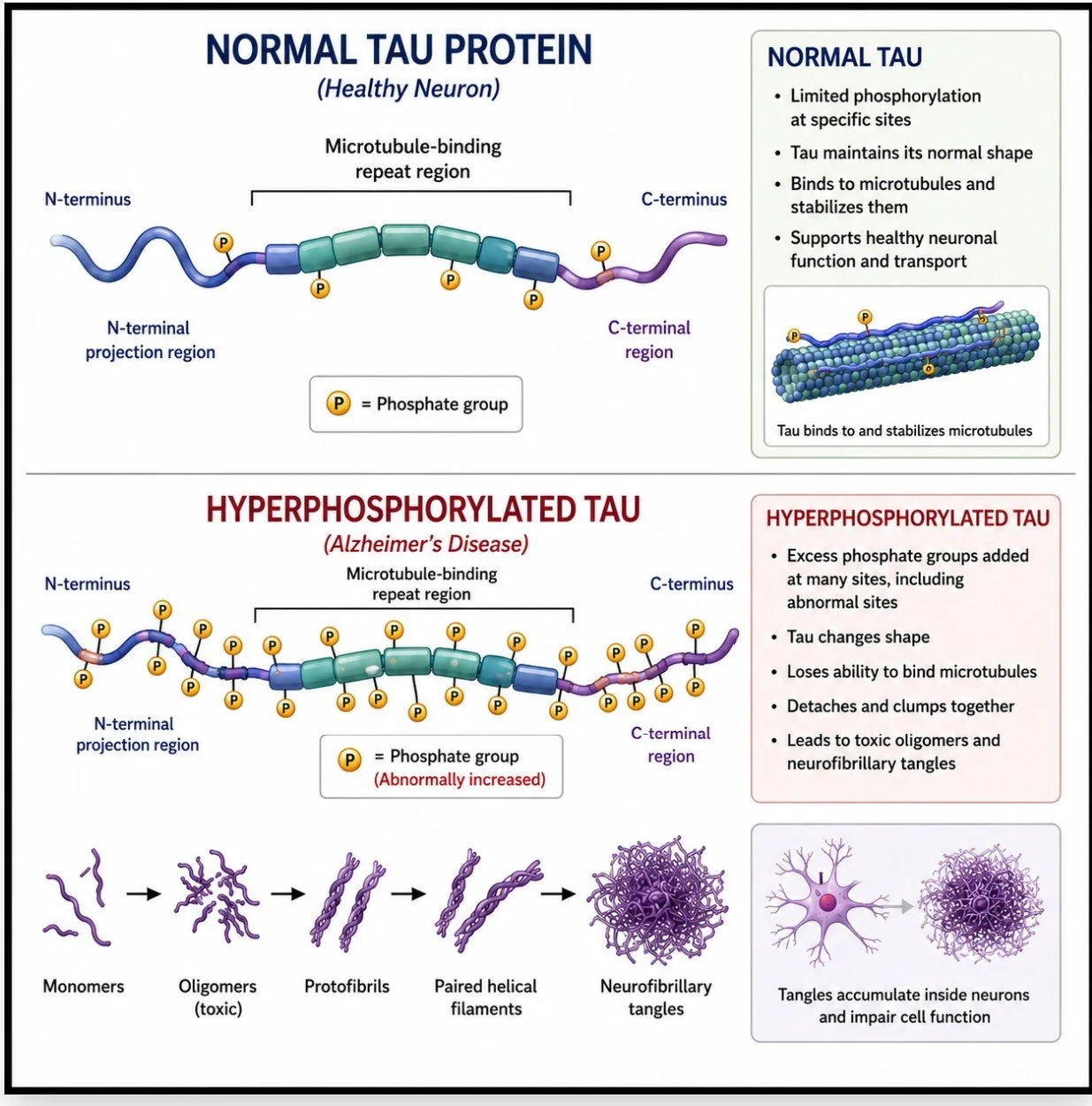
In a healthy brain, old soluble tau proteins are constantly broken down and replaced. Small tau fragments are normally released outside the neuron and swept away through the brain’s waste-clearing system, called the glymphatic system. This is part of normal cellular housekeeping.
The tangle problem may be triggered by amyloid plaque which damage tau protein perhaps causing too many phosphate to attach in the wrong places. This combination causes tau protein to lose its ability to cling to microtubules. Once the stabilizing tau pulls away, the internal tracks begin to weaken and break apart.
How are tangles formed
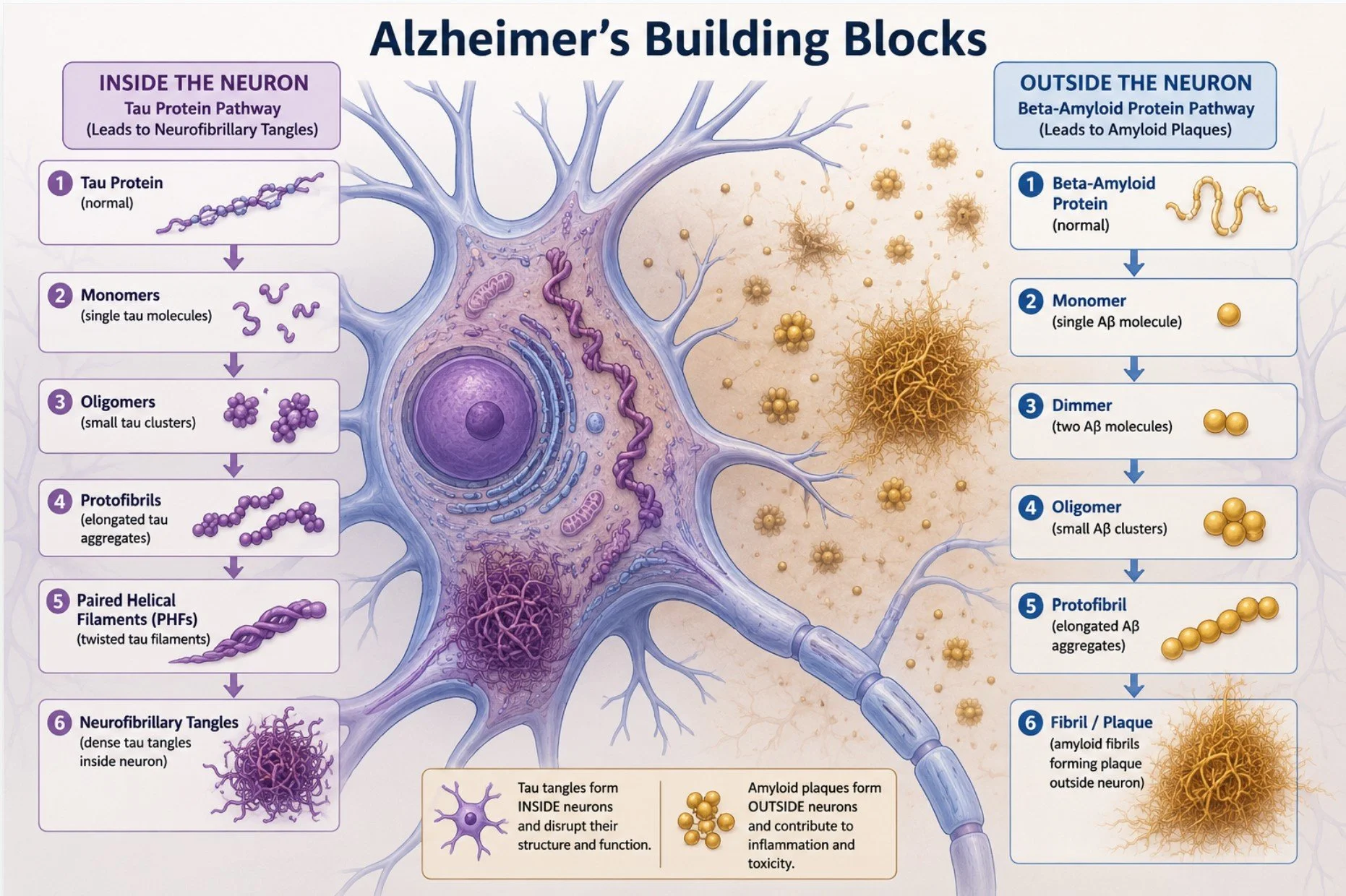
The damaged tau proteins then begin sticking to one another. Scientists believe the process starts with single abnormal tau molecules called monomers. These join together into small toxic clusters called oligomers. The oligomers combine into longer strands known as protofibrils. Eventually these twisted strands form paired helical filaments, rope-like fibers unique to tau disease. Over time, these fibers pack tightly together into dense neurofibrillary tangles inside the neuron.
This process is somewhat similar to how beta-amyloid plaques form, because both begin with small protein building blocks that gradually clump together. But there is one major difference. Amyloid plaques form outside neurons, while tau tangles form inside them. Plaques are more like piles of debris between cells. Tau tangles are more like knots clogging the machinery inside the neuron itself.
As tangles grow, the neuron’s internal transportation system begins to fail. Nutrients can no longer move efficiently. Mitochondria, the cell’s energy producers, malfunction. Synapses begin to deteriorate. Communication between neurons weakens, inflammation increases, and eventually the neuron dies.
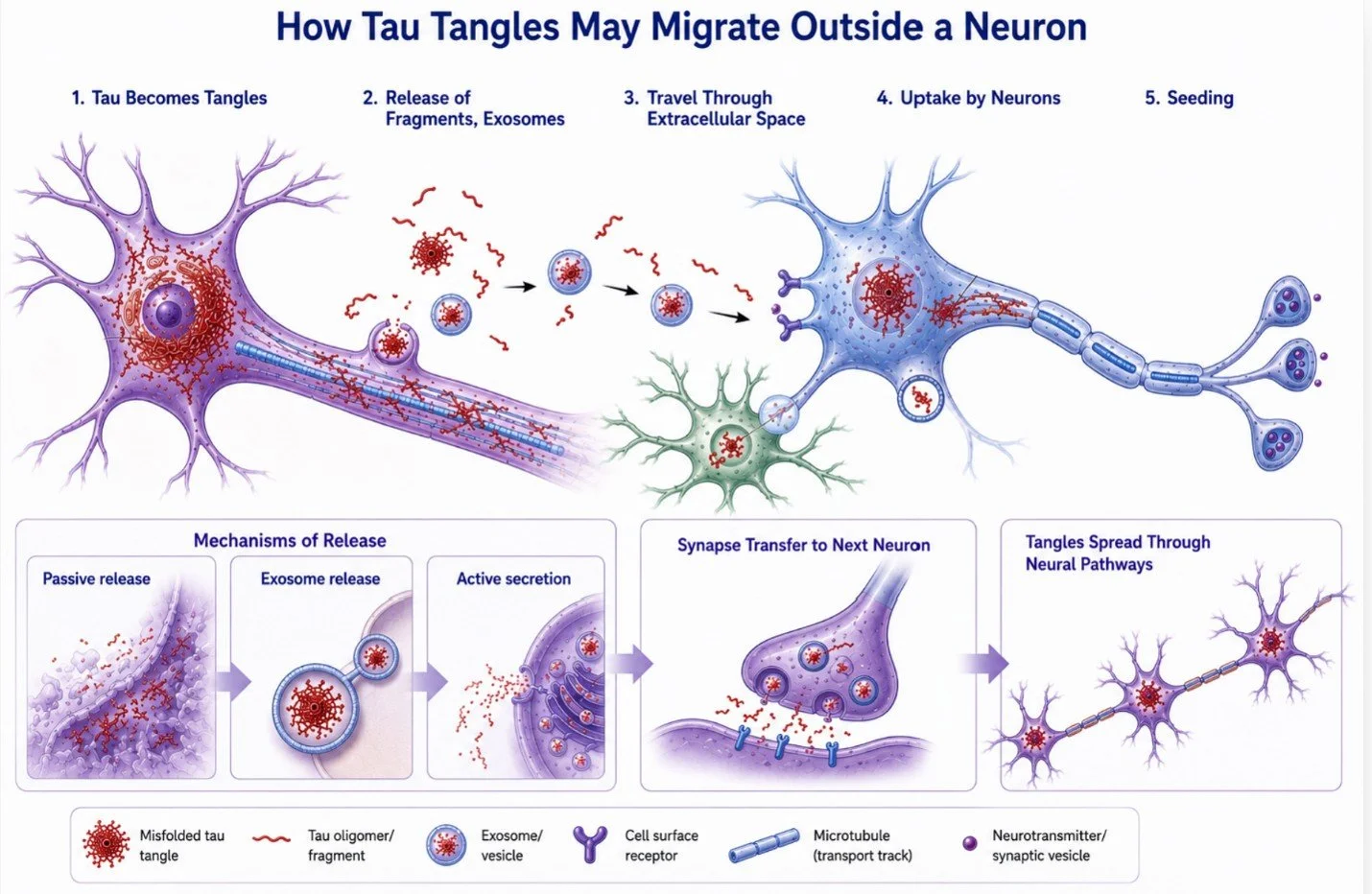
Scientists now believe tau pathology spreads through the brain in a chain-reaction-like process. Although full tangles are usually too large to travel intact, smaller abnormal tau fragments and oligomers can escape from damaged neurons.
How tau tangles spread
Like so many diseases, our body’s healthy processes are corrupted. The spread of tangles is one example.
Let’s start with our body’s healthy process. There are a few ways a healthy neuron constantly releases small amounts of proteins, membrane fragments, waste materials, and tiny vesicles called exosomes into the extracellular space (where plaque is found) around it. Healthy exosomes and protein fragments can act like tiny biological messages that unlike synapse connections, are absorbed and reused by nearby neurons and support cells. In many cases, they help neighboring cells coordinate normal brain activity, repair processes, and cellular communication.
While inside the neuron, many of these materials, including tau proteins and exosomes, are also transported along microtubule pathways through the axon toward the synapse, much like cargo moving along an internal railway system. At the synapse, neurons release neurotransmitters so neighboring neurons can communicate, but they also release small packets of cellular material as part of normal maintenance and signaling.
In Alzheimer’s disease, however, this normal release system become part of the problem. When neurons containing tau tangles become damaged, they release abnormal tau fragments, oligomers, and exosomes carrying misfolded tau (seeds) to nearby neurons and through the neural synapse directly into other neural pathways. Once inside a healthy neuron, the abnormal tau seeds may trigger normal tau proteins to misfold and begin tangling too. In this way, tau pathology may slowly spread through connected memory networks of the brain, almost like embers from a fire drifting into nearby forests and igniting new fires. Each newly damaged neuron may then release more abnormal tau, continuing the cycle.
Because synapses are points of extremely close contact between neurons, scientists believe these pathways may allow pathological tau to spread from one neuron to another, gradually carrying the disease through connected neural networks.
Hope for Our Future
The story of tau tangles is still being written, but the progress made in recent years offers real reason for optimism. Scientists now understand far more about how tau becomes damaged, how it spreads through the brain, and how it might be stopped. New therapies aimed at preventing tau misfolding, blocking its spread between neurons, enhancing its clearance, and protecting healthy brain cells are already being tested. Just as treatments such as Leqembi emerged from decades of amyloid research, many researchers believe today’s tau discoveries could lead to the next generation of Alzheimer’s therapies. At the same time, the search for solutions extends well beyond tau tangles. Scientists are also investigating inflammation, the immune system, blood vessel health, the glymphatic waste-clearing system, genetics, metabolism, and other factors that may contribute to Alzheimer’s disease. While much remains to be learned, the growing number of promising avenues being explored gives hope that future treatments will target multiple aspects of the disease and continue moving us closer to the day when Alzheimer’s can be prevented, stopped, or even cured.