
p-tau217 Blood Test: What Your Result Means
What is being measured?
When I first heard of this test, I thought it was giving me a measurement of the tau tangles that form inside a neuron. That is not the case.
Tau is a normal protein inside neurons. One of its jobs is to help stabilize the cell's internal "railroad tracks"—the microtubules that transport materials through the neuron.
The 217 in p-tau217 refers to a specific location on the tau protein: threonine 217. When tau becomes phosphorylated at that location, it is called phosphorylated tau 217, or p-tau217.
In Alzheimer's disease, the appearance and increasing amount of p-tau217 in blood appears to be closely associated with the biological process connecting amyloid pathology to tau pathology. Importantly, p-tau217 can rise before widespread tau tangles can be detected by tau PET.
So what is the blood test actually measuring?
Think of it this way:
Amyloid begins accumulating → neurons respond → tau becomes abnormally phosphorylated → small tau fragments containing p-tau217 enter the bloodstream → the laboratory measures those fragments.
So the blood test is looking for a chemical signal produced by the Alzheimer's process, rather than scooping up tau tangles themselves.
Scientists have found that measuring p-tau217 in the blood can provide information about the presence of abnormal beta-amyloid in the brain. In other words, p-tau217 is the blood signal; amyloid pathology is what that signal can help indicate.
Think of your car's check-engine light.
The light itself is not the engine problem. It is a signal produced by the car that tells you something may be wrong inside the engine.
Similarly:
p-tau217 = the blood signal
Amyloid pathology = the biological change the signal can help indicate
What is amyloid pathology?
Amyloid pathology means that abnormal beta-amyloid has accumulated in the brain.
Our brains naturally produce beta-amyloid, and normally it is cleared. In Alzheimer's disease, beta-amyloid can accumulate and eventually form the amyloid plaques associated with the disease. An amyloid PET scan can detect these deposits in the brain.
The p-tau217 blood test does not measure the amyloid plaques themselves. Instead, it measures a change in tau in the blood that is strongly associated with the presence of amyloid pathology.
And this distinction is important:
p-tau217 can provide a blood signal that indicates the presence of abnormal beta-amyloid in the brain. It does not tell us how much tau, or how many tau tangles, are in the brain. (Figdore, 2024)
What does my p-tau217 number mean?
This is where your laboratory report cutoff is a laboratory-established number that separates test results into different categories. It is a dividing line used to help interpret the result it is not a measure of how much Alzheimer's disease a person has. A cutoff is a laboratory-established number that separates test results into different categories. It is a dividing line used to help interpret the result it is not a measure of how much Alzheimer's disease a person has. becomes important.
There is not one universal p-tau217 number that applies to every laboratory test. Different laboratories use different methods to measure p-tau217. Because the methods are different, their numbers and cutoffs can also be different.
That means you should always interpret your result using the reference range and cutoff on your own laboratory report.
Think of the cutoff as a dividing line, not a score. A cutoff is a laboratory-established number that separates test results into different categories. It is a dividing line used to help interpret the result it is not a measure of how much Alzheimer's disease a person has.
For example, Labcorp's standalone p-tau217 test, Test #484390, uses the Fujirebio Lumipulse method. For this test:
0.00–0.18 pg/mL is within the laboratory's reference range.
A result above 0.18 pg/mL is interpreted as being consistent with amyloid pathology.
The 0.18 pg/mL cutoff is not a measurement of how much Alzheimer's disease you have.
For example:
A result of 0.10 does not mean you have a small amount of Alzheimer's.
A result of 0.25 does not mean you have a particular amount of Alzheimer's.
A result of 0.50 does not mean your disease is twice as severe as someone with a result of 0.25.
The number is simply being compared with the cutoff established for that particular test.
Why can two laboratories give different numbers?
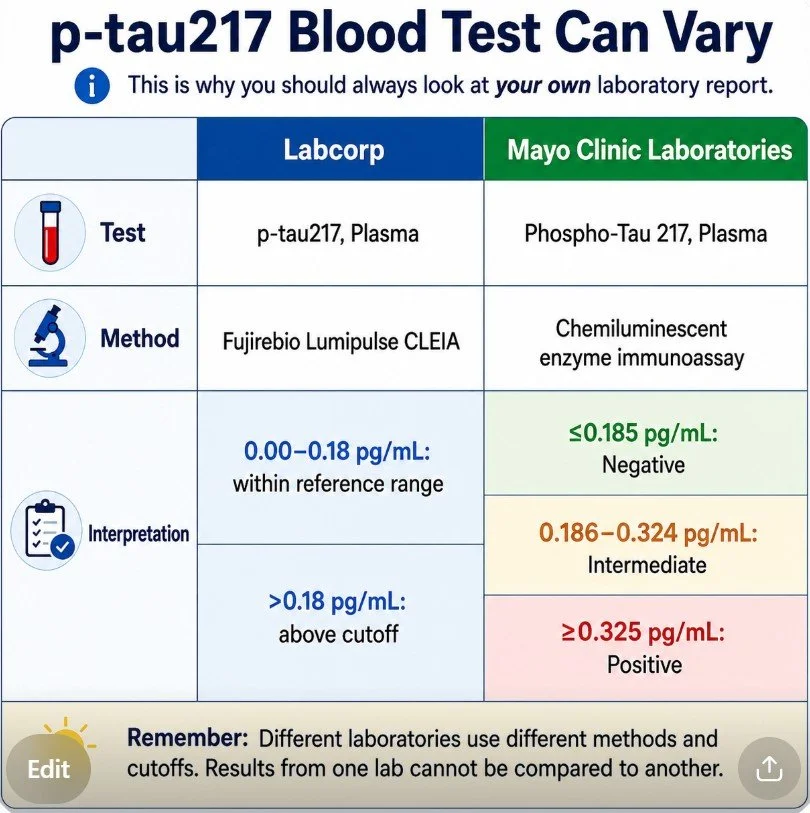
This is one of the most important things to understand when reading a p-tau217 report.
The word assay simply means the laboratory's method for measuring something in a sample.
Different laboratories can use different p-tau217 assays. Even though they are measuring the same general biomarker, their testing methods are not identical. As a result, the numbers and cutoffs cannot necessarily be compared from one laboratory to another.
Labcorp and Mayo: An example
Here is a good example of why you should always look at your own laboratory report.
Labcorp
Mayo Clinic Laboratories
Test
p-tau217, Plasma
Phospho-Tau 217, Plasma
Method
Fujirebio Lumipulse CLEIA
Chemiluminescent enzyme immunoassay
Interpretation
0.00–0.18 pg/mL: within reference range
≤0.185 pg/mL: Negative
>0.18 pg/mL: above cutoff
0.186–0.324 pg/mL: Intermediate
≥0.325 pg/mL: Positive
(Ashton, 2024) (Phospho-Tau 217, Plasma, 2026)
Labcorp uses 0.18 pg/mL as its cutoff. Mayo uses three categories, including an intermediate range.
So imagine two people receive these results:
Person A Labcorp
p-tau217 = 0.25 pg/mL
Person B Mayo
p-tau217 = 0.25 pg/mL
It would be a mistake to assume that the two people have exactly the same result simply because the numbers are both 0.25.
On the Labcorp test, 0.25 is above its 0.18 cutoff.
On the Mayo test, 0.25 falls into the intermediate range.
This is why you should never interpret a p-tau217 number without knowing which laboratory test produced it.
What does an intermediate result mean?
Some laboratories, such as Mayo, have an intermediate range.
An intermediate result means the blood test does not provide a clear enough answer by itself. Additional evaluation may be needed, such as an amyloid PET scan or cerebrospinal-fluid testing.
This illustrates an important point: a blood test is one piece of the diagnostic picture. Doctors also consider symptoms, cognitive testing, medical history, neurological examination, and other biomarkers or imaging when necessary.
What p-tau217 can and cannot tell you?
A p-tau217 result can provide important information about the biological changes associated with Alzheimer's disease, particularly amyloid pathology.
But p-tau217 is not a measurement of memory loss, disease severity, or the number of tau tangles in the brain.
The number on your report is therefore not an Alzheimer's score.
It is a laboratory measurement that is compared with a cutoff established for the particular test that was used.
This is why someone who has just received a p-tau217 result may understandably look at the report and wonder:
“Is a higher number worse? How much Alzheimer's do I have?”
The p-tau217 number does not answer those questions.
Most importantly:
The number on your p-tau217 report is not a score for how much Alzheimer's disease you have. It is a laboratory result that must be interpreted using the reference range and cutoff for the specific test that was performed.
Who is currently using p-tau217?
1. Memory clinics and neurologists
The most established clinical use is in specialized memory-care settings. The Alzheimer's Association's 2025 guideline focuses on people who already have objective cognitive impairment such as MCI or dementia and are being evaluated by clinicians experienced in memory disorders. (Palmqvist, 2025)
For these patients, a high-performing blood biomarker can be used either as a triage test or, when it meets higher accuracy standards, as a potential alternative to amyloid PET or cerebrospinal-fluid testing.
2. Clinical laboratories
p-tau217 is no longer confined to research laboratories. For example, Labcorp currently offers standalone plasma p-tau217 testing (Test #484390). Labcorp says the test can aid in the biological identification of Alzheimer's disease and can also be used for monitoring patients receiving newly approved anti-amyloid therapies. (Phosphorylated Tau 217 (pTau-217), Plasma, 2026)
Importantly, Labcorp's standalone test is a laboratory-developed test and has not been cleared or approved by the FDA.
3. Patients being evaluated for amyloid pathology
The test is particularly useful when a physician is trying to determine whether a person's cognitive symptoms are associated with Alzheimer's disease. It can potentially reduce the need for an amyloid PET scan or spinal tap in appropriate circumstances. The FDA cleared the Lumipulse G pTau217/β-Amyloid 1-42 Plasma Ratio in May 2025 for adults 55 and older with signs and symptoms of Alzheimer's disease. That test measures both p-tau217 and Aβ42 and calculates a ratio; it is not the same as Labcorp's standalone p-tau217 test. (Release, 2025)
4. Clinical researchers and drug trials
Researchers are using p-tau217 to help identify people with Alzheimer's pathology for clinical trials and to study biological responses to anti-amyloid treatments. Labcorp specifically notes that p-tau217 has been used to monitor participants in anti-amyloid clinical trials.
What are the future opportunities?
Earlier and easier diagnosis
This may be the biggest opportunity.
A blood test is considerably easier to obtain than an amyloid PET scan or spinal tap. If highly accurate blood tests can be used reliably, they could make Alzheimer's biological diagnosis available to many more people. The Alzheimer's Association guideline specifically recognizes the potential of blood biomarkers to improve access to diagnosis and disease-modifying therapies. (Palmqvist, 2025)
Moving into primary care
This is an important next step.
The Alzheimer's Association's current guideline is focused on specialized care, but the organization is already developing tools for integrating blood biomarkers into primary care. Labcorp also has a primary-care pathway for Alzheimer's blood biomarkers. (ALZPro, 2026)
That could eventually mean a person who notices persistent memory changes might have a blood biomarker test ordered by a primary-care physician before being referred to a memory specialist.
But that is not yet the same thing as recommending p-tau217 as a general screening test for healthy people. Current guidance is still centered on people with objective cognitive impairment.
Helping doctors select people for treatment
This could become particularly important as Alzheimer's disease-modifying treatments become more widely used.
A blood test could help determine whether someone has the biological evidence needed to consider an anti-amyloid treatment, potentially reducing the need for PET imaging or CSF testing.
And eventually, researchers may be able to use changes in blood biomarkers over time to help monitor biological responses to treatment. Labcorp already lists monitoring of patients on anti-amyloid therapy as a use for its p-tau217 test, although the broader clinical standard for treatment monitoring is still developing.
What are the challenges?
1. Different tests give different numbers
This is particularly important for your article.
There is no single universal p-tau217 number that can be applied to every laboratory test. Different assays can produce different numerical results and therefore require their own cutoffs.
The Alzheimer's Association guideline specifically notes substantial variability among commercially available blood biomarker tests.
This means patients cannot simply search the internet for "normal p-tau217" and compare their number with someone else's result.
2. False-positive and false-negative results
No blood test is perfect.
A result can sometimes incorrectly suggest that amyloid pathology is present or fail to detect it when it is present. This matters because a blood test could influence decisions about additional testing and potentially about treatment.
The FDA specifically cautions that the cleared p-tau217/Aβ42 ratio test is not a stand-alone diagnostic test and should be interpreted with other clinical information and evaluations. (Release, 2025)
There has also been a real-world reminder of this challenge: the FDA posted a Class II recall/correction involving certain lots of the Lumipulse p-tau217/Aβ42 plasma ratio test because of concerns about falsely elevated results. The FDA stated that affected results should be interpreted with other diagnostic tools and clinical information.
3. Standardization
Researchers and laboratories need better agreement about how p-tau217 is measured and how results are reported.
This is one reason your Labcorp-versus-Mayo illustration is so valuable. A patient may see 0.25 pg/mL on one report and 0.25 pg/mL on another, but the clinical interpretation may not be the same because the assays and validated cutoffs differ.
4. Knowing what the number actually tells us
This is probably the most important message for your readers.
p-tau217 is not an Alzheimer's severity score.
It can provide evidence associated with amyloid pathology, but it does not tell a person how much memory loss they will experience, how many tau tangles are present, or exactly how far their disease has progressed.
The current diagnostic framework also distinguishes p-tau217 from biomarkers that more directly represent AD tau proteinopathy, such as tau PET and certain other tau measures.
Future Opportunities
The future of p-tau217 may be much bigger than simply replacing a PET scan. A simple blood test could eventually help doctors identify Alzheimer's biology earlier, determine who needs more specialized testing, help guide decisions about disease-modifying treatment, and perhaps help monitor biological changes during treatment.
But for that future to become reliable, scientists and laboratories still need to standardize testing, establish consistent cutoffs, understand how results should be interpreted over time, and make sure that blood-test results are used together with a person's symptoms and clinical evaluation.
References
ALZPro. (2026). Retrieved from Alzheimer's Association: https://www.alz.org/alz-pro
Ashton, N. J. (2024, January 22). Diagnostic Accuracy of a Plasma Phosphorylated Tau 217 Immunoassay for Alzheimer Disease Pathology. Retrieved from JAMA: https://jamanetwork.com/journals/jamaneurology/fullarticle/2813751
Figdore, D. J. (2024, July 19). Optimizing cutpoints for clinical interpretation of brain amyloid status using p,asma p-tau217 immunoassays. Retrieved from Alzheimer's Association: https://alz-journals.onlinelibrary.wiley.com/doi/10.1002/alz.14140
Palmqvist, S. W. (2025, July 29). Alzheimer's Association Clinical Practice Guideline on the use of blood-based biomarkers in the diagnostic workup of suspected Alzheimer's disease within specialized care settings. Retrieved from Alzheimer's Association: https://alz-journals.onlinelibrary.wiley.com/doi/10.1002/alz.70535
Phosphorylated Tau 217 (pTau-217), Plasma. (2026). Retrieved from LabCorp: https://www.labcorp.com/tests/484390/phosphorylated-tau-217-ptau-217-plasma
Phospho-Tau 217, Plasma. (2026). Retrieved from Mayo Clinic Laboratories: https://neurology.testcatalog.org/show/PT217
Release, F. N. (2025, May 16). https://www.fda.gov/news-events/press-announcements/fda-clears-first-blood-test-used-diagnosing-alzheimers-disease. Retrieved from FDA.gov: https://www.fda.gov/news-events/press-announcements/fda-clears-first-blood-test-used-diagnosing-alzheimers-disease