Why Alzheimer's Affects Short-Term Memory: 7 Strategies That Really Help
I've reached a point where my Alzheimer's has slowed enough that I can begin to see more clearly what damage it has left behind. One problem stands out above all the others: my short-term, working, and prospective memory.
It shows up in the smallest, most frustrating ways.
Did I already brush my teeth?
Why am I opening this drawer?
Why did I walk into this room?
What did I just do?
A thought to do something just flitted by. Where did it go?
I don't remember that ever happening.
These moments aren't occasional, they happen throughout my day. They force me to confront an uncomfortable truth: something in my brain has changed permanently.
My first question was, "Why is this happening?" But eventually I realized the better question was, "How can I work around it?"
What Happens in Our Brain to Disrupt Short-Term, Working, and Prospective Memory?
One of the earliest and most frustrating symptoms of Alzheimer's disease is the inability to hold onto new information for even a few minutes. You may wonder why you can read an email, walk into another room, or think of something important, only to have it disappear almost immediately.
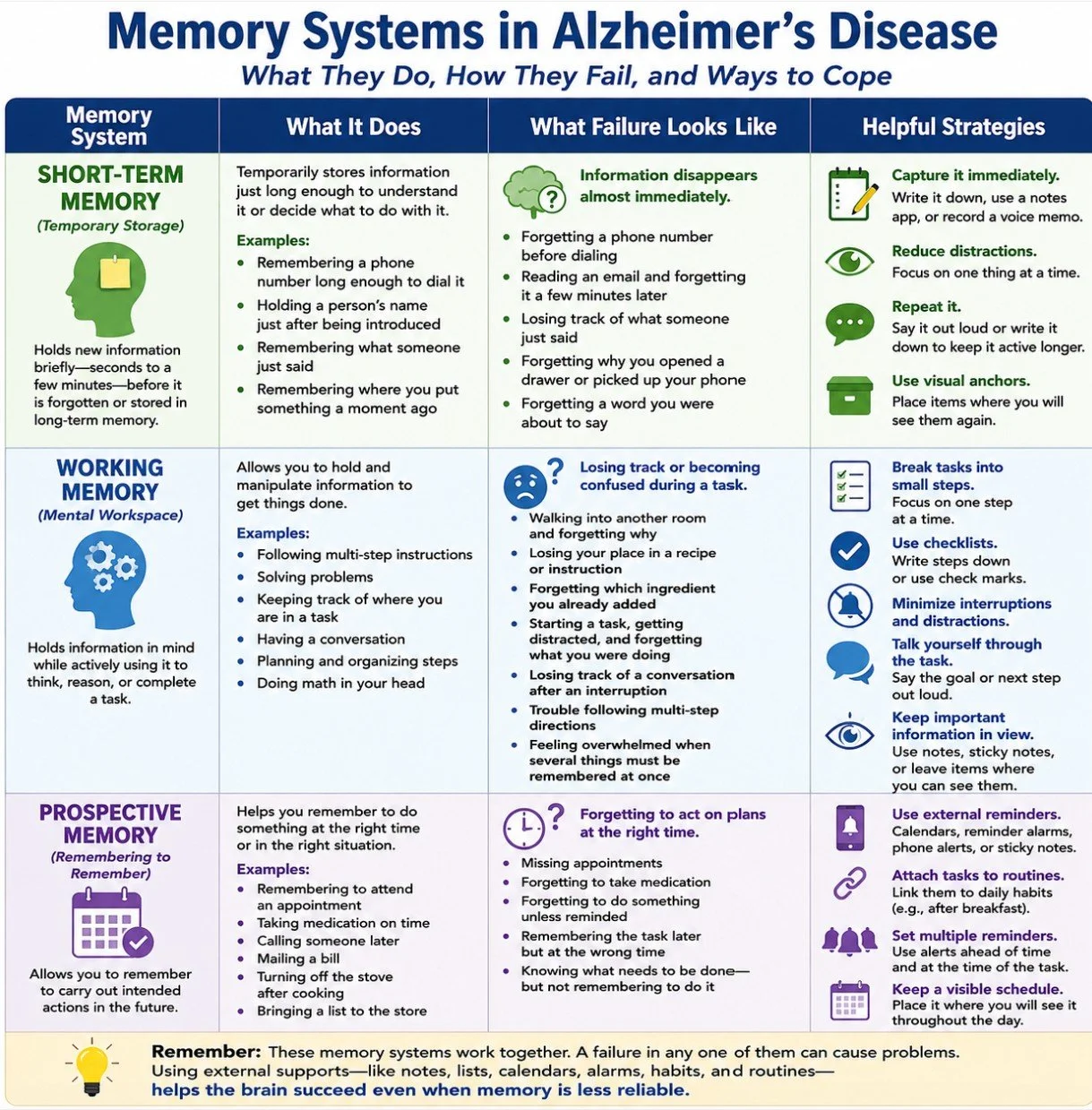
The answer lies in three closely connected memory systems: short-term memory, working memory, and prospective memory. Although each serves a different purpose, they work together continuously throughout the day. Alzheimer's disease disrupts all three.
Short-Term Memory
Short-term memory is the brain's temporary holding area. It keeps new information available for a few seconds or minutes while the brain decides what to do with it.
In Alzheimer's disease, this holding system becomes unstable. Information fades quickly because the nerve cells responsible for maintaining it can no longer communicate as efficiently as they once did. As a result, you may read an email and forget it a few minutes later, lose a phone number before dialing it, or forget what someone just told you.
Think about the five words your doctor asks you to remember during a memory test or office visit. I can remember those words, but only if I keep repeating them over and over. Some people create mental associations to help. Whatever method you use, it requires constant concentration. While I'm focused on remembering the words, I can't pay attention to the conversation. For people with Alzheimer's, it's an either-or situation: concentrate on the words or follow the discussion, we simply can't do both. I usually opt for remembering the words.
Working Memory
Working memory is the brain's mental workspace. It allows you to keep information in mind while using it to complete a task, solve a problem, or carry on a conversation.
Working memory depends on healthy communication between several brain regions, especially the frontal lobes, which organize attention, planning, and decision-making. Alzheimer's disease weakens these communication networks. Messages are interrupted, attention is easily lost, and information slips away before the task is finished.
This is why you may walk into another room and forget why you went there, lose your place while following a recipe, forget which step comes next, or lose track of a conversation after someone interrupts.
Prospective Memory
Prospective memory is your brain's reminder system. It allows you to remember that something needs to be done in the future without someone reminding you.
This type of memory requires several brain systems to work together. You must form an intention, keep it active in the background, recognize the right time or situation to act, and then carry out the task.
Alzheimer's disease disrupts this entire process. The intention gradually fades, the brain fails to recognize the cue that should trigger the action, or attention shifts before the task is completed.
As a result, you may forget to take your medication, miss an appointment, forget to return an important phone call, or leave home without the shopping list you intended to bring.
Understanding What's Happening in My Brain
I've learned that short-term and working memory aren't controlled by just one part of the brain. They're the result of several brain regions working together:
The prefrontal cortex holds information in the moment.
The parietal lobes keep attention focused.
The temporal lobes process words and sounds.
The hippocampus decides what information will be stored.
With Alzheimer's, damage can occur in any part of this network. Where the damage occurs and how extensive it becomes is different for every person. The important point is that the memory often isn't lost, it was never fully formed in the first place because the brain couldn't properly encode it.
Why Memory Strategies Work
These memory failures all share the same underlying cause. Alzheimer's damages the brain networks responsible for keeping information active from one moment to the next.
While we can't fully restore these damaged systems, we can reduce the burden placed on them. Writing things down immediately, using reminder alarms, following routines, and creating consistent habits all provide external support for a brain that struggles to keep information active. These strategies don't cure the problem, but they can dramatically improve everyday life.
Facing Reality and Opportunity
I've come to accept that my short-term memory may never return to what it once was. That's a difficult truth, but it's also a freeing one.
Instead of spending my energy trying to fix something that may not be fixable, I've chosen a different approach. I'm learning to work with my brain as it is now, not as it used to be.
That shift in thinking changed everything.
Seven Strategies That Help Me Every Day
1. Use External Supports: My Backup Brain
I no longer rely on memory alone.
I use reminders, alarms, and notes.
I follow one simple rule:
Do it now, or record it now.
2. Build Strong Routines
I reduce decision-making by turning repeated actions into habits.
Follow the same sequences every day.
Create structure in my environment.
Let repetition become my ally.
My experience: I've learned that repeated behaviors gradually become automatic through implicit memory. The less I have to consciously remember, the better my day goes.
3. Train My Awareness (Metacognition)
I actively monitor my own actions.
I say important actions out loud.
"I locked the door."
"I took my medication."
I pause and check myself before moving on.
This helps my brain better encode what I've just done.
4. Use the Pause–Confirm–Move Method
After every important action, I:
Pause for two or three seconds.
Confirm what I just did (out loud or mentally).
Then move on.
This simple habit has reduced many of my "Did I do that?" moments.
5. Focus on One Thing at a Time
Multitasking is no longer my friend.
Eliminate distractions during important tasks.
Don't think ahead while doing something.
If my attention is divided, the memory often never forms.
My experience: This is one of my biggest challenges. I'm easily distracted. If I receive a text message, phone call, or even start thinking about lunch, my original task often disappears from my mind.
6. Design My Environment to Support Me
Instead of depending on memory, I depend on systems.
Keys always go in one place.
Important items have fixed locations.
I use physical cues, like touching the stove knob before leaving the kitchen.
My experience: Cleaning out cupboards, organizing my home, and always putting my purse and keys in the same place have made daily life much easier.
7. Write It Down Immediately
If something matters, I write it down—or record it immediately.
No delay.
No exceptions.
My experience: I've also learned to keep only one notebook. I used to write reminders on scraps of paper that later disappeared. One notebook has become my external memory.
My Commitment Moving Forward
The biggest change hasn't been in my memory, it's been in the way I think about it.
I used to believe success meant restoring what Alzheimer's had taken away. Now I understand that real progress comes from adapting. Every routine I build, every reminder I use, and every habit I strengthen helps me live more independently and confidently.
My memory has changed, but my ability to adapt has not.
That's what I'm choosing to build on.
And if you're facing the same challenges, I hope you'll remember this: while Alzheimer's may change the way your brain works, it doesn't take away your ability to learn new ways of living well.